
Soil Water Potential vs Water Content: Pair the Measurements Before Setting Thresholds
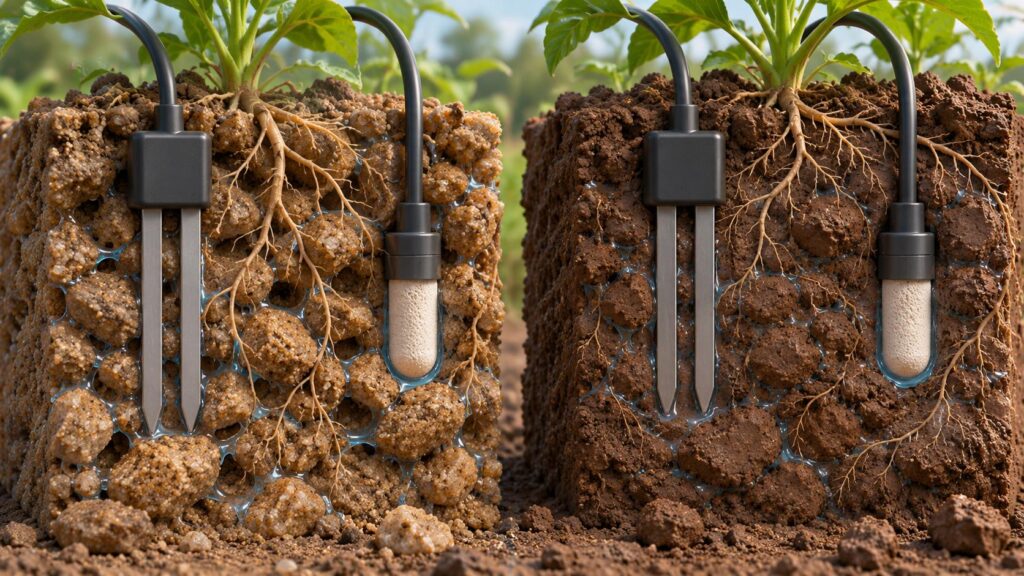
Soil water potential vs water content is a comparison of two related but different quantities. Water content describes how much water is present; water potential describes its energy state relative to a reference. Neither can be replaced by the other through a universal conversion. Use the soil, sensor method and measurement conditions to interpret the relationship.
Name the reported quantity
Volumetric water content is the volume of water relative to soil volume. Gravimetric content uses a mass basis. Water potential is commonly reported using pressure units, but its meaning depends on the component and reference measured.
Campbell's soil water status paper distinguishes content and potential. The soil moisture calculation guide helps identify the content basis. Keep these definitions in exported data rather than labeling both channels simply as soil moisture.
Understand the soil-specific relationship
Different pore structures can retain water differently. The same volumetric content in two soils need not correspond to the same potential. A soil water-retention curve expresses a relationship under specified conditions, rather than a generic conversion between percentage and pressure.
METER's soil moisture explanation describes retention curves and their soil dependence. Confirm how a curve was established and its applicable range before using it in a field interpretation. Do not extrapolate it simply because a software calculation permits it.
Distinguish matric from total potential
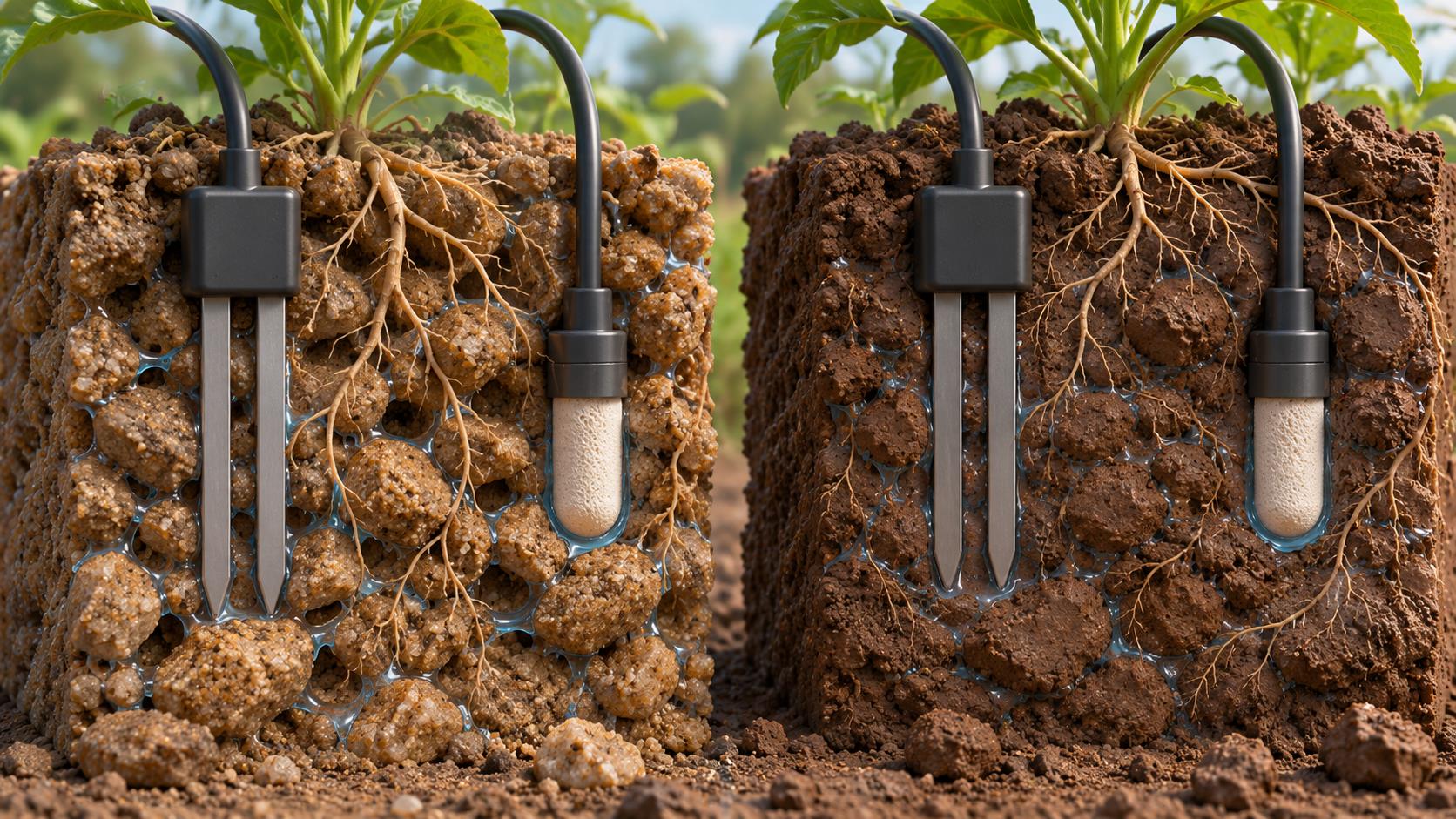
Water interacts with soil surfaces, dissolved substances, gravity and pressure. Different instruments may respond to different components. A matric-potential measurement should not automatically be described as a measurement of every contribution to total potential.
METER's water-potential guide explains these components. State what the sensor measures. In saline conditions, review the osmotic contribution separately rather than assuming a matric reading captures the full effect of dissolved salts.
Pair sensors at meaningful depths and times
Install each sensor according to its requirements for contact, preparation and orientation. Nearby devices can sample different soil volumes or wetting patterns. Pair timestamps and document depth, zone and irrigation events before deciding that two channels disagree.
The soil monitoring network installation guide helps define those records. A reading from one point is not automatically the average condition of the root zone. Consider spatial variability when choosing the number and placement of measurement locations.
Check sensor and model limits
Review the useful measurement range, environmental limits and required calibration of each device. A displayed endpoint or invalid code must not be treated as a real stable soil condition. Maintain quality flags and inspect unexplained jumps against installation or maintenance events.
For water-content sensors, the soil-specific calibration guide separates conversion assumptions from field verification. Potential sensors have their own preparation and verification requirements. A good curve cannot compensate for poor contact or an out-of-range instrument.
Build thresholds from application evidence
Use paired measurements to understand wetting, drying and the soil's response over time. Keep the interpretation consistent with the crop, depth, soil and measurement method. A threshold from another field or a differently defined parameter may not transfer.
Review management decisions with appropriate agronomic evidence. Preserve raw values, curve versions and any calculated channels. Do not derive irrigation or nutrient changes from a single sensor value without considering the broader field condition and the purpose of the monitoring system.
Frequently asked questions
Can VWC be converted directly to kPa? Only through an appropriate relationship or model with relevant soil data. There is no universal unit conversion.
Do all potential sensors measure total potential? No. Confirm the component and method in the device documentation.
Why can two soils at the same water content behave differently? Their pore structure and retention characteristics can differ, changing the relationship between content and potential.