
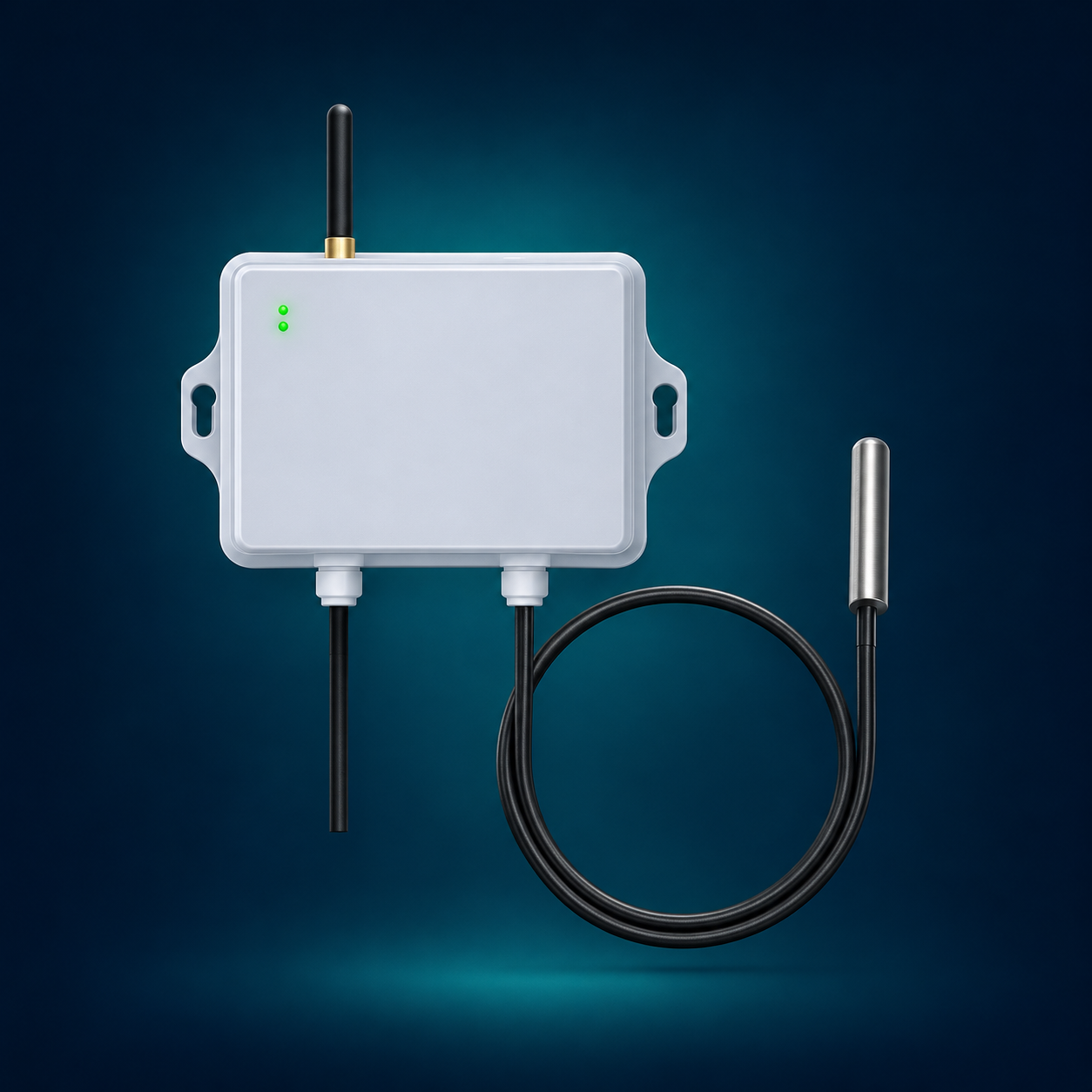
YF500-T Industrial Temperature Transmitter is an environmental monitoring device. Choose the sensor and communication configuration for the measurement and installation requirements.
Industrial temperature measurement
Temperature monitoring points should represent the equipment or environment being measured. Compare the measurement range with the actual installation conditions and the required controller interface.
Technical specifications
| Parameter | Specification |
|---|---|
| Temperature Range | -55°C ~ 125°C |
| Resolution | 0.1°C |
| Accuracy | ±0.5°C (-10°C ~ 85°C) |
| Response Time | Fast Response Digital Sensor |
| Service Life | 10 Years |
| Parameter | Specification |
|---|---|
| Power Supply | DC10~30V |
| Standard Communication | RS485 Modbus RTU |
| Analog Output | 4-20mA / 0-5V |
| Wireless Communication | LoRaWAN / WiFi / Bluetooth / 4G |
| Relay Output | Single Relay Output (Optional) |
| Relay Application | Heating / Cooling / Ventilation Control |
| Parameter | Specification |
|---|---|
| Housing Material | Flame-Retardant ABS |
| Protection Rating | IP67 |
| Operating Temperature | -20°C ~ 60°C |
| Operating Humidity | 0~99%RH (Non-condensing) |
| Model | Description |
|---|---|
| YF500-T(R) | RS485 Modbus Temperature Transmitter |
| YF500-T(20) | 4-20mA Temperature Transmitter |
| YF500-T(V5) | 0-5V Temperature Transmitter |
| YF500-T(L) | LoRaWAN Temperature Transmitter |
| YF500-T(W) | WiFi Temperature Transmitter |
| YF500-T(B) | Bluetooth BLE Temperature Transmitter |
| YF500-T(4G) | 4G Cellular Temperature Transmitter |
YF500-T industrial temperature transmitter
The YF500-T is a temperature transmitter for environmental and equipment monitoring. Its listed temperature measurement range is −55 to 125 °C, with 0.1 °C resolution and ±0.5 °C accuracy over the stated −10 to 85 °C interval. Select the probe, output and installation arrangement for the actual project conditions.
Measurement point and application
Temperature readings are useful only when the sensor is positioned to represent the condition of interest. A probe used to observe room air, a surface or material near equipment may see different temperatures. Identify what needs to be measured and how the reading will be used before specifying the mounting point.
In storage, production and utility environments, consider air movement, nearby heat sources, sunlight and the operating schedule. Record the sensor location and compare trends under similar conditions. Where several zones have different exposure or equipment, separate monitoring points may be appropriate.
Measurement range and operating limits
The measurement range of the sensing element is different from the operating environment permitted for the transmitter assembly. The product table separately lists a main-unit operating temperature of −20 to 60 °C and non-condensing humidity of 0–99% RH. Review all component limits, cable routing and exposure for the installation.
The stated ±0.5 °C accuracy applies over −10 to 85 °C. Do not assume the same accuracy at every point of the full listed measurement range. Resolution describes the reporting increment and is not the same as accuracy.
Output and system integration
RS485 Modbus RTU is listed as the standard communication. The ordering options include analog and wireless configurations. Identify the required output, power supply and receiving controller, and confirm the selected model and any accessories before installation.
For a connected monitoring system, document the point name, interface settings and reporting requirements. Verify that the reading reaches the correct controller or data collection point during commissioning.
Installation and maintenance
Follow the supplied instructions for mounting the probe and transmitter. Protect the cable from tension, abrasion and excessive heat. Provide safe access for inspection and avoid positioning the sensing element where surrounding equipment creates an unrepresentative local reading.
Inspect the probe, cable and enclosure routinely and use the specified cleaning and verification procedure. For a quotation, share the measurement medium, expected temperature, installation environment and preferred interface. Explore the industrial sensor range and industrial monitoring solution.
Selection and integration
Industry applications
- Manufacturing
- Process industries

Selection and installation considerations
Define whether the requirement concerns ambient air, a process point or another medium. Compare the measurement range with the operating limits of the electronics and enclosure, then confirm mounting and wiring. Keep probe response, installation effects and calibration requirements in the purchasing brief.