
Soil Moisture Content Calculation: Gravimetric and Volumetric Methods
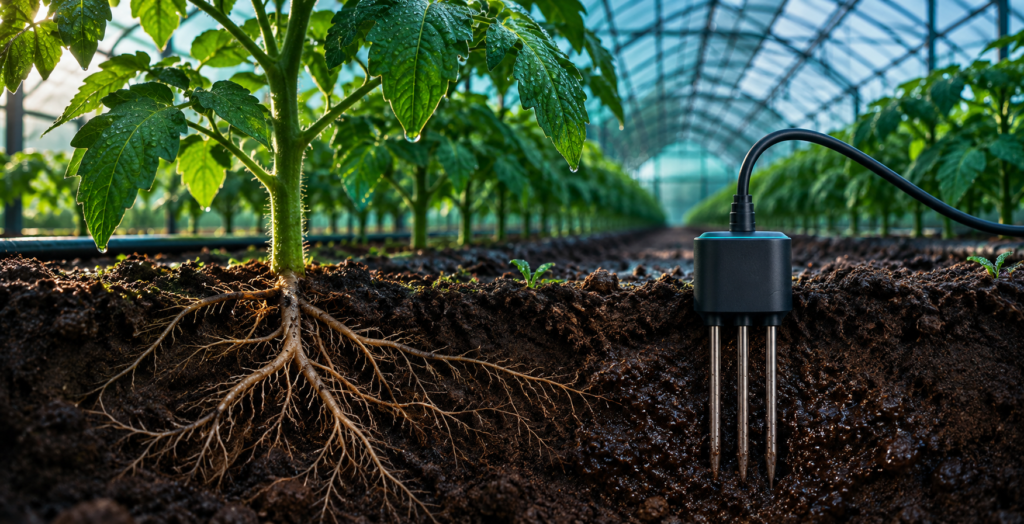
Soil moisture content calculation tells you how much water is present in a soil sample or root zone. The answer depends on the basis: gravimetric water content compares water mass with dry soil mass, while volumetric water content compares water volume with the total volume of soil. A percentage from one method cannot be substituted for the other without knowing the soil bulk density.
For growers, the useful question is not simply whether a number is high or low. It is whether the measurement represents the root zone, responds to irrigation and rainfall, and helps the operator decide when and how much water to apply. This guide explains the calculation, shows a worked example and connects a laboratory reference to continuous field measurements.
Gravimetric water content: calculate water by mass
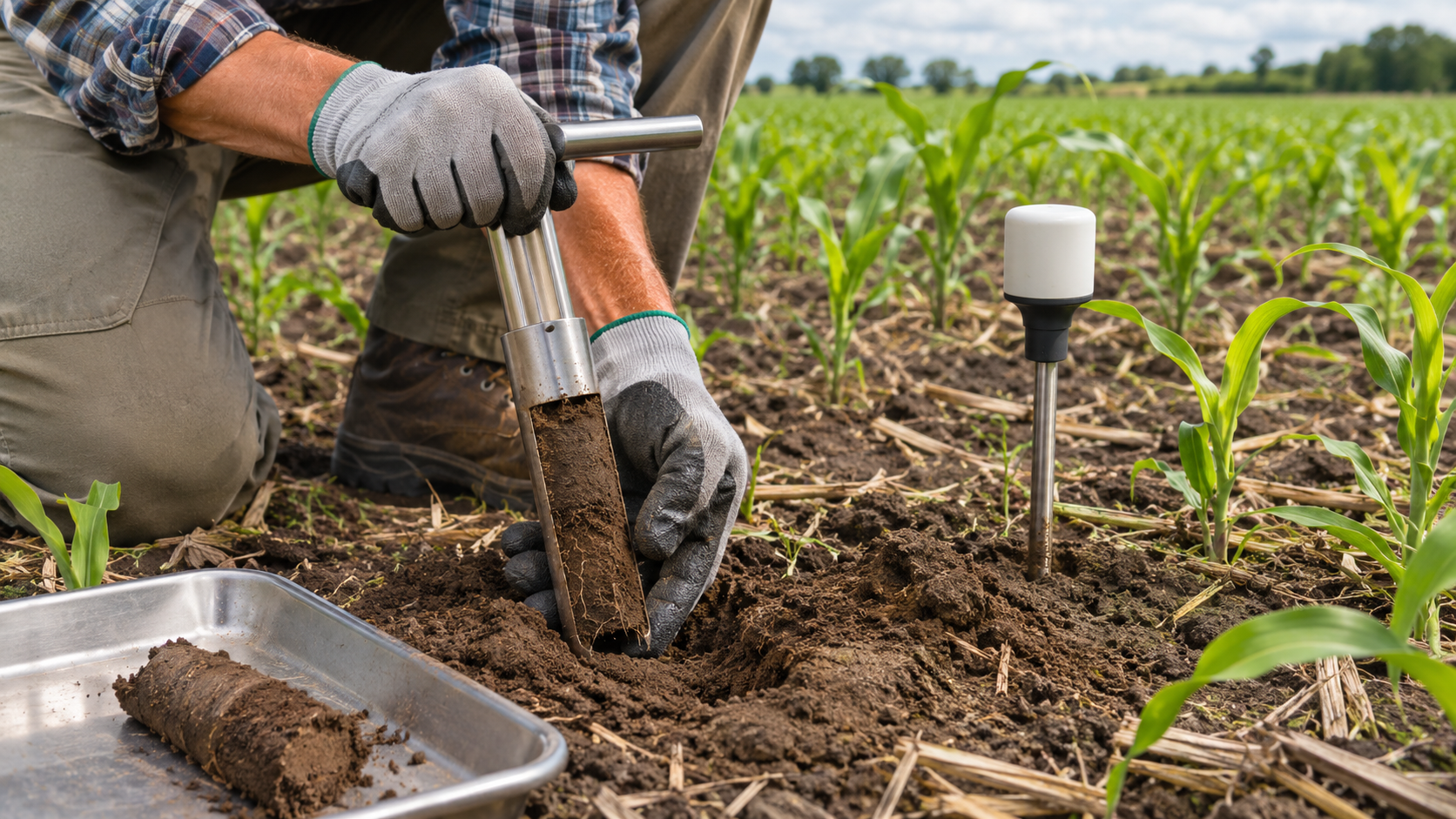
Collect a representative sample, protect it from moisture loss and weigh it before and after drying using an appropriate laboratory procedure. Subtract the container mass from both measurements. The dry soil mass is the denominator:
Gravimetric water content (%) = (wet soil mass − dry soil mass) ÷ dry soil mass × 100.
Suppose the wet soil weighs 120 g and the dry soil weighs 100 g, excluding the container. The sample contains 20 g of water, so its gravimetric water content is 20%. Using the wet mass as the denominator would answer a different question and give 16.7%; do not mix the two definitions when comparing measurements. Organic-rich samples and unusual materials may require specific drying procedures, so follow the chosen laboratory method rather than assuming every sample behaves identically.
Volumetric water content: calculate water by volume
Volumetric water content, or VWC, equals water volume divided by total soil sample volume. A VWC of 25% means approximately 25 units of water volume per 100 units of bulk soil volume. The bulk volume includes soil solids and pore space.
The conversion from gravimetric water content uses dry bulk density and water density:
VWC = gravimetric water content as a decimal × dry soil bulk density ÷ water density.
In the example above, a gravimetric fraction of 0.20 and dry bulk density of 1.3 g/cm³ give a VWC of approximately 0.26, or 26%, assuming water density is approximately 1.0 g/cm³. The density must describe the same soil layer and sampling conditions. A guessed bulk density makes the converted value uncertain; compaction and sampling disturbance can change the result.
Turn volumetric content into water depth
For a uniform layer, multiply VWC as a decimal by layer thickness. At 26% VWC across a 300 mm layer, the water stored is approximately 78 mm. This is total water in that layer, not water necessarily available to the crop. If an illustrative field-capacity value for that same layer is 32%, the difference is (0.32 − 0.26) × 300 = 18 mm. This example is a storage difference, not a universal irrigation recommendation: crop roots, rainfall, drainage, irrigation efficiency and the measured soil's actual field capacity all matter.
For a layered profile, calculate each layer separately and add the results. A reading at one depth should not automatically be treated as an average for the entire root zone. Soil texture, stones, root distribution and irrigation uniformity can make adjacent locations very different.
Soil water content is not soil water tension
Content describes how much water is present; tension describes how strongly the soil holds water. Two soils can have the same VWC but make that water available to roots differently. Compare content with local measurements of field capacity and lower management limits, rather than applying a single percentage to every crop and soil. Tension measurements can add useful context when plant water availability is the operational question.
How a soil moisture sensor supports the calculation
Many continuous sensors estimate water content indirectly from a soil property, such as dielectric response. The conversion to VWC depends on the sensor design and calibration. Salinity, temperature, density, soil texture and air gaps around a probe can affect readings; the size of each effect depends on the device and site. A sensor trend can be useful even where a site-specific absolute calibration is needed.
Install sensors in representative management zones and at depths that reflect active roots. Avoid wheel tracks, atypical low spots and the immediate edge of a drip emitter unless that micro-location is the deliberate target. Maintain firm soil contact around the sensing surface, follow the probe's installation instructions and document depth, orientation, crop, irrigation method and soil type. Monitor a wetting event after installation: a plausible rise and subsequent drawdown help assess whether the sensor is responding to the root zone.
Compare sensors with paired soil samples taken close in space and time. Record wet and dry masses, sample volume or bulk density, and sensor values. Repeat across the expected moisture range before adjusting a calibration; one sample does not establish performance under all conditions. Keep the original readings and calibration record so that a future change does not silently alter historical interpretation.
Choose a monitoring system
For manual checks, a sampling procedure and scale may answer occasional questions. For irrigation scheduling, a fixed probe and a compatible logger or controller provide a time series that shows wetting, drainage and root-zone depletion. Select the measurement range, installation method, cable length, power supply and communications based on the actual site. Confirm protocol and available configuration for the selected model.
Explore the ODSENSE soil sensor and smart agriculture sensors for applications that require continuous monitoring. For project planning, see greenhouse monitoring.
Frequently asked questions
Can gravimetric moisture exceed 100%?
Yes. Because the denominator is dry soil mass, a very wet or organic sample may contain more water by mass than dry solids. That does not mean its volumetric water content exceeds 100%.
Is a higher VWC always better?
No. Excess water can reduce air-filled pore space and affect roots. Interpret measurements against crop needs, soil properties and drainage, not a universal target.
How often should a probe be calibrated?
Use the manufacturer's guidance and the needs of the project. Check the installation after disturbance or unexpectedly large disagreement, and document any adjustment.
Technical references: USDA soil laboratory manual; Oregon State University Extension: soil moisture monitoring; University of Minnesota Extension: irrigation sensors.