
Soil Moisture Sensor Calibration: Choosing and Checking a Soil-Specific Curve
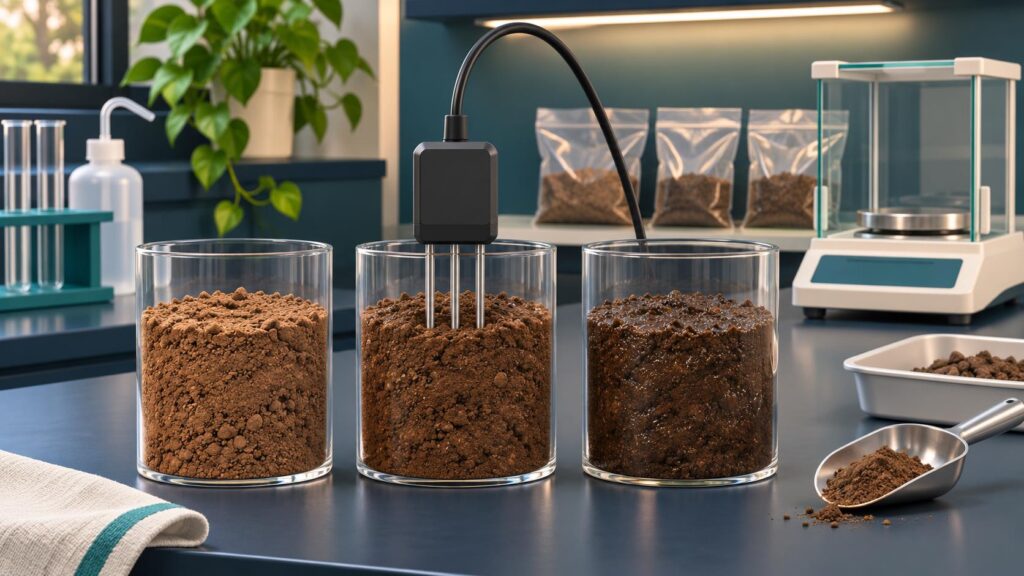
Soil moisture sensor calibration connects the instrument's response with a defined water-content reference. For dielectric sensors, a factory conversion may be suitable for a stated class of soils, while unusual soil or substrate conditions may justify a soil-specific relationship. First identify what the sensor reports, then decide what evidence is needed for the irrigation or research decision.
This guide is for agricultural integrators, growers and field-monitoring teams. It provides a planning and verification workflow rather than a universal calibration recipe. Use the exact sensor instructions and a suitable laboratory or field procedure; a curve developed for another model or soil should not be transferred without evaluation.
Define the measurement and the required accuracy
Identify whether the output is a raw electrical response, a dielectric quantity or already converted volumetric water content. Confirm which conversion the reader or gateway applies. A percentage without its definition is not enough to compare instruments or set irrigation limits. Our soil moisture calculation guide distinguishes volumetric from gravimetric water content.
Write down the decision the measurement supports and the acceptable uncertainty. Trend monitoring and a controlled research comparison may need different evidence. Check the factory calibration's stated soil class and conditions before assuming that a custom curve is necessary. Supplier accuracy claims remain specific to their model and procedure.
Choose soil that represents the intended application
Soil electrical response can be influenced by properties such as texture, density, mineral composition and salinity. A soil-specific calibration therefore needs samples and preparation that reflect the application. Record the sampling location, depth, soil description and relevant management conditions so the calibration has a defined scope.
Discuss how the sample will be packed or retained, and how its density compares with field conditions. A convenient loose sample in a pot does not automatically represent an undisturbed field profile. If the project includes substantially different soils or growing substrates, evaluate them separately rather than assuming one relationship applies everywhere.
Establish a defensible water-content reference
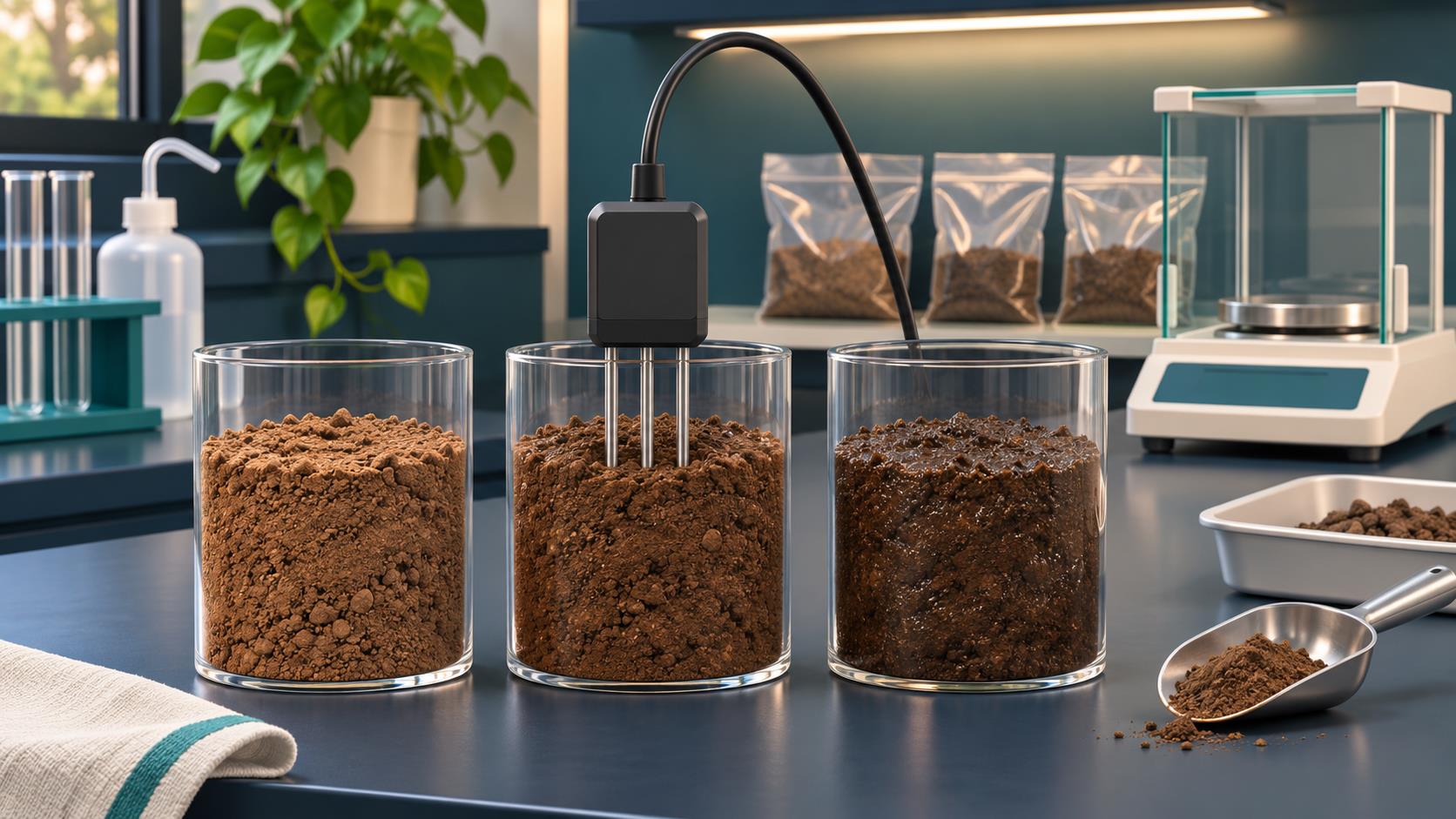
Agree how reference water content will be determined, including sample volume, mass measurements and the applicable drying procedure. Document the equipment and handling method. If converting a gravimetric reference to volumetric content, the density information must correspond to the material being evaluated.
Collect paired reference and sensor observations across the moisture conditions relevant to the project. Allow the prepared material and reading to become representative under the chosen method. Do not invent a curve from an air reading and a water reading: METER's quick-start guidance illustrates why a sensor calibrated for soil need not report the endpoints a user might expect in those media.
Validate the conversion with separate observations
Keep some suitable observations independent of those used to derive the relationship. Compare the converted readings with the reference under the validation conditions, and describe where the relationship is supported. A close fit to the data used to create a curve is not the same as evidence that it works at another site or moisture range.
Record residual differences and investigate systematic patterns rather than reporting only a single summary number. Check the conversion form and units expected by the receiving system. Retain the original sensor output where practical so that future changes to the equation remain traceable.
Investigate installation before changing coefficients
Poor soil contact, disturbed material, a damaged cable or an incorrect reader configuration can create misleading results. A revised equation should not be used to disguise an installation fault. Compare the installed arrangement with the model instructions and the conditions under which the calibration was evaluated.
Use the soil-monitoring installation checklist to review depth, contact and cable routing separately from the calibration question. When field readings differ, consider whether they reflect a real difference in soil conditions before forcing the sensors into agreement.
Preserve the curve and review irrigation thresholds
Save the sensor model, equation version, input units, reference method, soil description and validation record together. Confirm where the conversion is applied and prevent a second conversion in a downstream platform. Note which installations use each version and what changed when a new version is introduced.
Review existing irrigation thresholds after a justified calibration change; the old numerical limit may no longer represent the same condition. The smart agriculture sensor range can support a project discussion, but crop decisions also require the grower's soil and agronomic guidance. A new curve alone does not demonstrate improved yield or water savings.
Frequently asked questions
Should every soil moisture sensor use a custom calibration?
Not automatically. Assess the factory conversion, soil or substrate and required measurement quality. Use a custom procedure when the application and evidence justify it.
Can one soil-specific curve be used for every sensor model?
No. Raw outputs, sensing methods and conversion requirements can differ. Confirm the supported model, soil conditions and validation range before reuse.
Sources: METER soil-specific calibration guidance, METER soil sensor quick-start, METER soil calibration service method.