
Dissolved Oxygen mg/L vs Percent Saturation: Compare the Reference Conditions
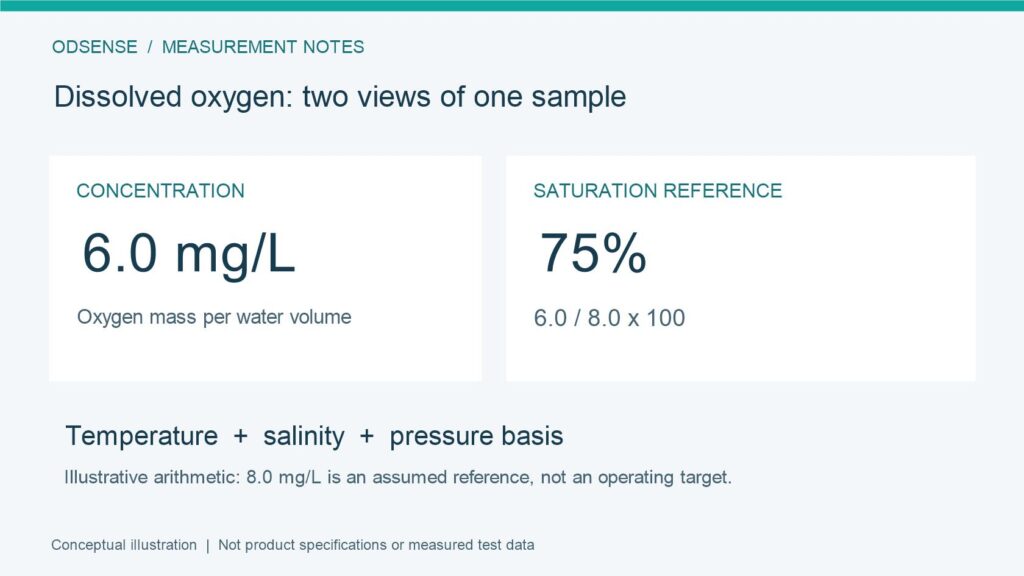
Dissolved oxygen mg/L and percent saturation answer different questions. mg/L describes oxygen mass per water volume; percent saturation compares that concentration with an equilibrium reference. To compare the two, identify the reference convention and use matching temperature, salinity and pressure inputs. A fixed multiplier cannot cover every water-monitoring installation.
Start with the quantity on the screen
A concentration reading helps describe oxygen available in the sampled water. A saturation percentage describes how that concentration relates to a selected equilibrium condition. Neither label alone tells you whether a probe was correctly installed or whether an operating alarm is suitable.
The EPA dissolved oxygen guidance explains that saturation depends on environmental conditions. Keep both units when they help interpretation, but identify one primary unit for each operational decision. For hardware considerations, start with the dissolved oxygen sensor selection guide.
Define the saturation reference before converting
Use the instrument manual to identify what its percent channel means. Some instruments distinguish a local-pressure saturation convention from a reference-pressure convention. Two channels named “DO %” are not necessarily calculated identically. Record the pressure basis and compensation settings instead of assuming that every display uses the same definition.
For a locally defined equilibrium calculation, water temperature, salinity and atmospheric pressure establish the saturation concentration. Use the sample conditions associated with the oxygen reading, not a temperature from another depth or a salinity setting left over from commissioning. Confirm whether the pressure input is actual local pressure or a weather-service value corrected to sea level.
Use a calculation with explicitly matched inputs
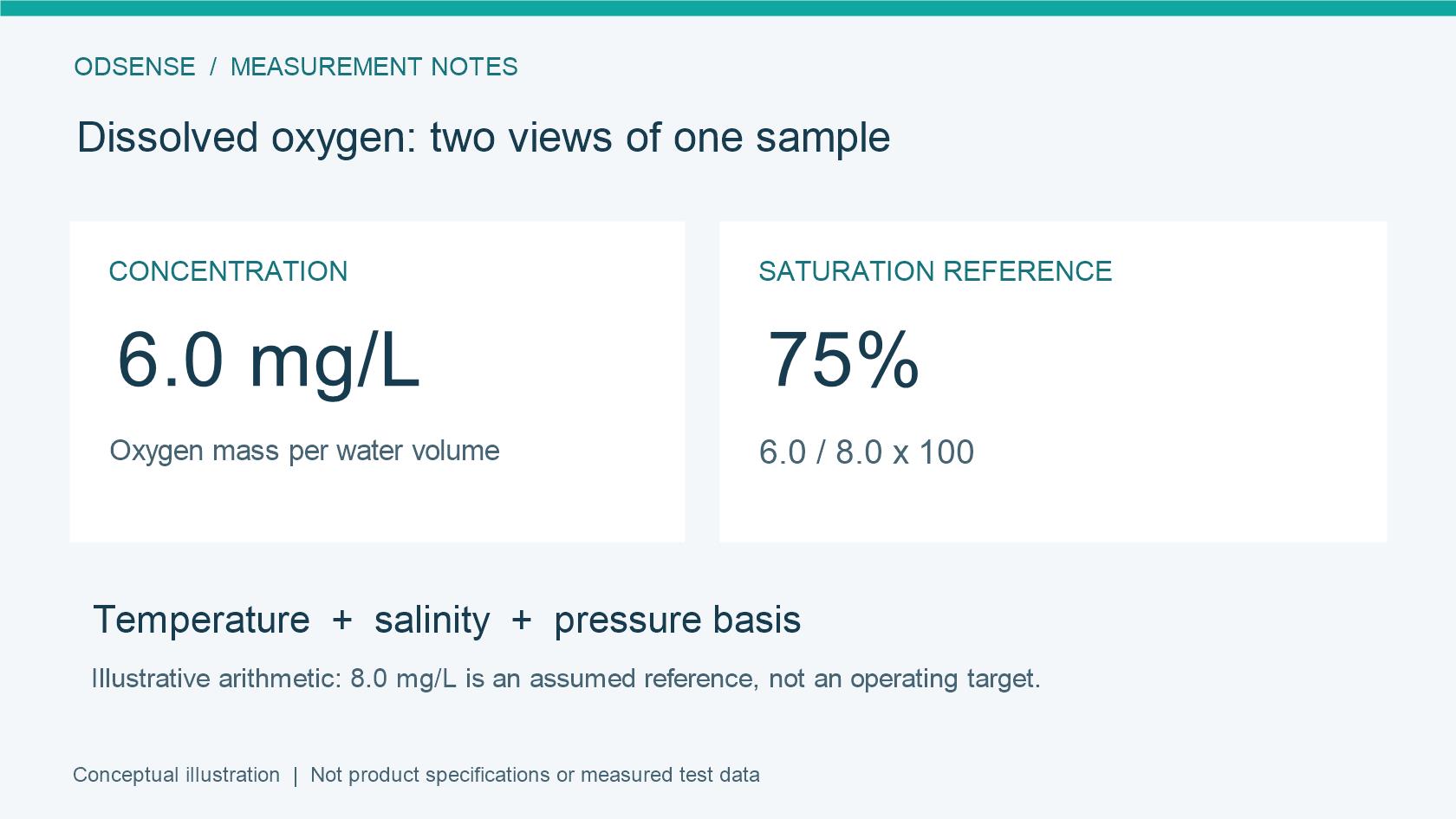
For the concentration-based definition used by USGS DOTABLES, percent saturation equals measured concentration divided by the applicable saturation concentration, multiplied by 100. The reverse calculation multiplies saturation concentration by the percentage divided by 100. Use a documented calculation within its stated input limits.
As an arithmetic example only, suppose the applicable equilibrium concentration is 8.0 mg/L and the measured value is 6.0 mg/L. The result is 75% saturation. The assumed 8.0 mg/L is not a lookup value for unspecified water and is not an alarm recommendation. Changing the reference conditions changes the denominator.
Diagnose disagreements before recalibrating
First compare timestamps, depth, stabilization and sample movement. Then compare temperature channels, salinity entries, pressure units and percentage definitions. If mg/L agrees but percentages differ, investigate the reference calculation. If both differ, check sampling conditions and probe condition before attributing the discrepancy to unit conversion.
A reading above 100% can reflect supersaturation, but it can also require investigation of settings, bubbles or measurement conditions. Do not automatically clamp the value to 100%. Follow the DO calibration checks before changing calibration coefficients.
Keep alarm rules and records consistent
Define alarms using the process or species requirement, with responsibility assigned to the operator. A percentage threshold does not represent one constant mg/L value across all temperatures and salinities. Avoid converting an established concentration alarm into a fixed percentage without reviewing the operating range.
Store both readings where available, along with temperature, salinity source, pressure basis, instrument identifier and maintenance state. The USGS Bay glossary illustrates why measurement definitions belong with the data. For electrochemical installations, also review the amperometric sensor service questions.
Specify the data handover clearly
Ask the supplier or integrator for the exact channel definitions and the compensation inputs used by the transmitter and dashboard. Confirm that the controller does not apply a second correction to an already compensated value. Demonstrate one documented conversion during acceptance, then retain the settings with the monitoring record.
Frequently asked questions
Is 100% saturation always the same mg/L? No. The applicable equilibrium concentration depends on the reference conditions.
Can I use temperature alone for conversion? Only when the other required conditions and assumptions are explicitly known and appropriate.
Does a unit mismatch prove sensor failure? No. Check the calculation convention and synchronized input data before changing the sensor.