
Conductivity Cell Constant: Match the Probe, Meter and Range
The conductivity cell constant relates the conductance measured by a probe to the conductivity of the liquid. Check the expected measurement range and meter compatibility together. When a probe is replaced, confirm which cell constant the meter actually uses before assuming a sudden change comes from the water.
Understand the relationship and units
Conductance is measured in siemens. For a compatible cell and meter, multiplying conductance by the effective cell constant gives conductivity. A cell constant in inverse centimetres combined with conductance in microsiemens gives conductivity in microsiemens per centimetre. The Thermo Fisher conductivity overview explains the relationship and the role of the cell geometry.
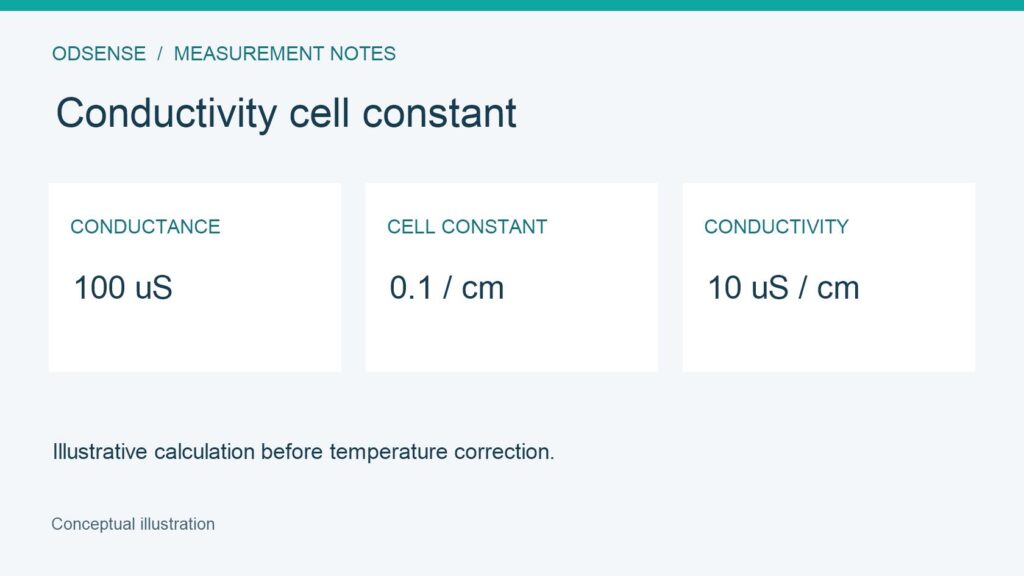
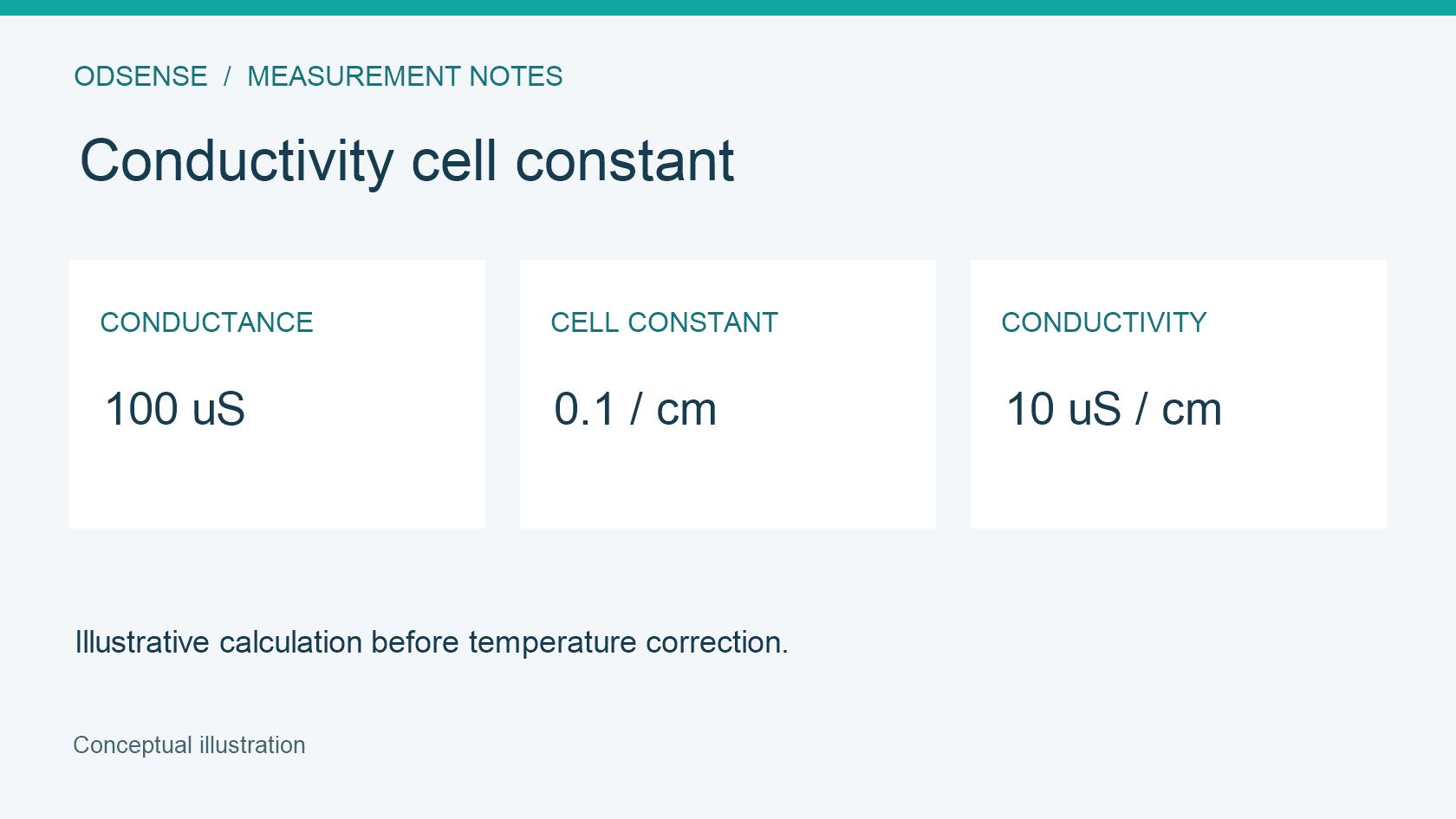
As an arithmetic example, a conductance of 100 microsiemens and a cell constant of 0.1 inverse centimetres give 10 microsiemens per centimetre before any temperature correction. Use the water conductivity guide for the wider measurement context.
Select the probe for the expected working range
Start with the lowest and highest values the system needs to distinguish. Then check the documented range for the specific probe and meter pair. A lower cell constant is often used for lower conductivity in two-electrode designs, but the nominal constant alone does not establish the usable range. Sensor construction, electrode polarization and the readout also matter.
The Hamilton sensor selection guide compares two- and four-electrode designs. Consider sample compatibility, coating and the manufacturer's installation clearances when choosing a sensor.
Confirm the active constant after replacement
Record the old and new probe identifiers, the nominal or certified constant and the meter configuration. Some systems read data from the probe. Others rely on an entered value or a calibration that determines the effective constant. Confirm the actual workflow in the manual.
Review the complete signal path. A meter may already publish a conductivity value, so a downstream controller that applies the cell constant again can create a scale error. Compare the local reading and exported value in the same units.
Verify against a suitable standard
Use the standard specified by the instrument procedure for the intended range. Record the standard's value, temperature basis and lot, and allow the measurement to stabilize. Keep the sensing region properly immersed or filled according to the design. Avoid bubbles and carryover between samples and standards.
The USGS specific conductance manual describes one-point determination of the cell constant using a known solution. The appropriate calibration and verification sequence still depends on the instrument and application.
Trace an unexpected change
A roughly proportional error after replacing a cell warrants checking the constant and engineering-unit scaling. An error that varies as temperature changes warrants checking the temperature channel and compensation setting. Follow the conductivity temperature compensation guide to compare values on the same temperature basis.
Unstable readings can also arise from bubbles, incomplete wetting or contamination. Low-conductivity samples are especially sensitive to handling. See the distilled and purified water guide for interpretation limits.
Keep a record that supports the next replacement
Save the selected range, units, cell constant, compensation mode, probe identifier and verification results with the commissioning record. If the controller consumes a digital or analogue signal, retain the configured mapping as well. This makes a later trend shift easier to trace to water conditions or a change in the measurement chain.
Frequently asked questions
Is the nominal constant sufficient to order a replacement? Confirm the specified range, connection, compatibility and calibration procedure for the exact probe and meter.
Does changing the constant perform temperature compensation? The constant converts conductance to conductivity. The temperature algorithm reports the result on a selected temperature basis.