
Tipping Bucket Rain Gauge Calibration: Check More Than the Pulse Count
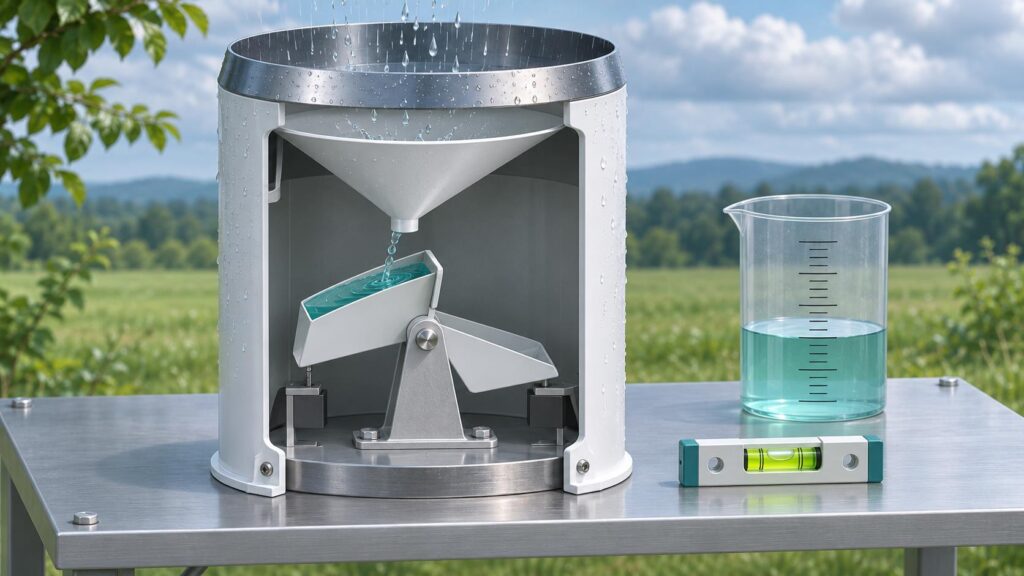
Tipping bucket rain gauge calibration checks the relationship between collected water and recorded rainfall. Manually tipping the bucket can confirm that pulses reach a logger, but it does not establish how much rain each tip represents. Start with the instrument identity and calibration record, then inspect the gauge and test the full measurement chain using the approved water-delivery procedure.
Identify the coefficient and reported quantity
Record the gauge model, collection opening, configured rainfall per tip and units. Use the certificate or approved model documentation to identify the applicable coefficient. A nominal family value and an individual calibration value are not automatically interchangeable.
The Campbell ARG100 manual distinguishes model settings from individual calibration factors. Its numerical procedure applies to that instrument. For a broader explanation of rain detection, accumulation and intensity, see the rain sensor and rain gauge comparison.
Inspect before adjusting the mechanism
Check the funnel, drain path and bucket assembly for leaves, insects, deposits or restricted movement. Verify the mounting level using the instrument's specified method. Record the condition before cleaning so that a later change can be interpreted.
Follow the manual for disassembly and approved cleaning materials. Do not begin by turning adjustment screws to compensate for a blocked funnel or tilted base. Reassemble the gauge without changing its collection geometry, and confirm that cleaning has not obstructed drainage or disturbed the mount.
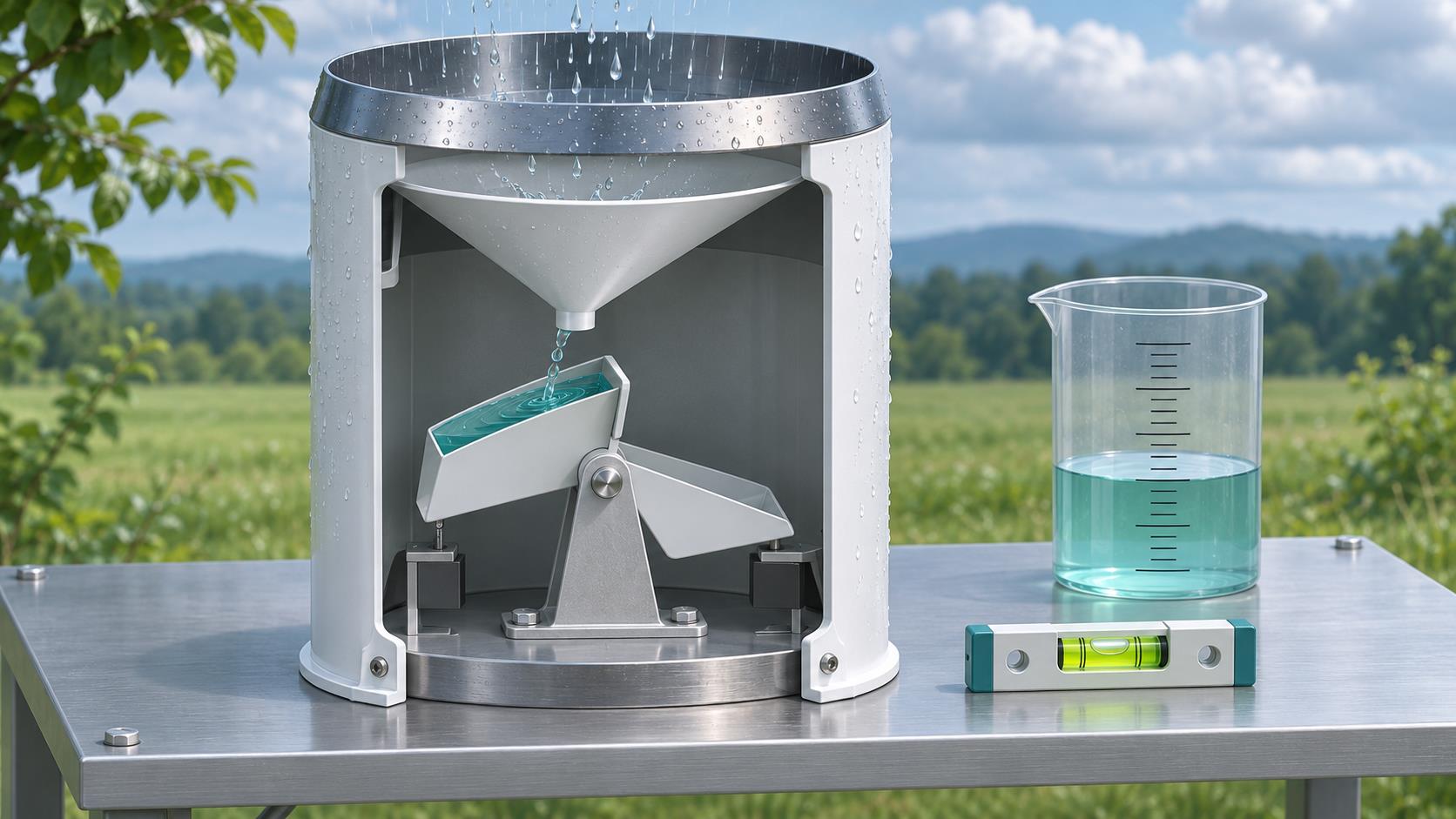
Test the pulse path separately
Use the manufacturer's approved functional check to compare bucket movement with logger counts. Check the input type, wiring, pulse filtering and unit conversion. A displayed rainfall increment depends on both detected pulses and the configured coefficient, so inspect the underlying count where available.
Keep functional tests distinct from calibration. A correctly counted mechanical movement does not validate catch efficiency or water volume per tip. The environmental measurement planning guide helps define which measurements and records are needed for the farm or monitoring project.
Control water volume and delivery rate
Use the model's approved test volume, delivery apparatus, preparation and test rate. Record the actual quantity, duration, initial bucket condition and final count. A quick pour can challenge the mechanism differently from a controlled drip and can invalidate the intended comparison.
Campbell's rain gauge test article explains why the water test and its timing must be recorded. Set acceptance criteria from the actual model and project requirements. Do not copy another instrument's volume, target count or adjustment sequence simply because both use tipping buckets.
Separate intensity effects from collection losses
A gauge that agrees at one test rate may behave differently at another. Campbell's intensity correction discussion explains the mechanism's rate dependence and a product-specific correction approach. This does not justify applying the same correction to a different gauge.
Field collection also depends on exposure, wind, obstructions and splash conditions. A bench check cannot validate all of those effects. Review the surrounding installation and the measurement objective before interpreting disagreement with a distant weather station as proof that the coefficient is wrong.
Preserve the maintenance and data record
Mark the test interval so added water is not mistaken for natural rainfall. Preserve raw counts, the old and new coefficient if changed, timestamps, test conditions and the reason for any adjustment. Maintain a clear boundary between observed data and corrected data.
After servicing, confirm normal logging and compare suitable subsequent events with the project reference. When reviewing industrial sensor selection requirements, include the maintenance process and access requirements. A successful initial test does not remove the need for ongoing inspection.
Frequently asked questions
Does manually tipping the bucket calibrate the gauge? No. It is a functional check of movement and counting. A calibration check also needs the approved water quantity and test conditions.
Can one fixed coefficient correct every rainfall intensity? Do not assume that. Use the manufacturer's documented correction method, if supported, and keep its applicability limits.
Should test water remain in rainfall totals? Identify and handle the maintenance interval under the project's data-quality procedure. Retain the original record and the correction history.