
Soil Electrical Conductivity: Why Moisture and Measurement Method Matter

Soil electrical conductivity is useful only when the measured quantity and conditions are clear. An in-soil bulk EC reading is not automatically equivalent to pore-water EC or a laboratory extract result. Read the parameter definition, keep moisture and temperature records, and use a method-matched comparison before applying a salinity threshold or drawing a management conclusion.
Name the EC quantity before comparing values
Bulk EC describes conduction through the soil volume experienced by a probe. Pore-water EC describes the liquid in the pores. Extract EC depends on a defined preparation and extraction method. Even when the displayed units match, the underlying quantities can differ.
METER's soil EC measurement guide compares these methods. Record the exact output definition and any calculation used by the device. A channel labeled only EC leaves too much uncertainty for a later cross-site comparison.
Interpret moisture changes alongside EC
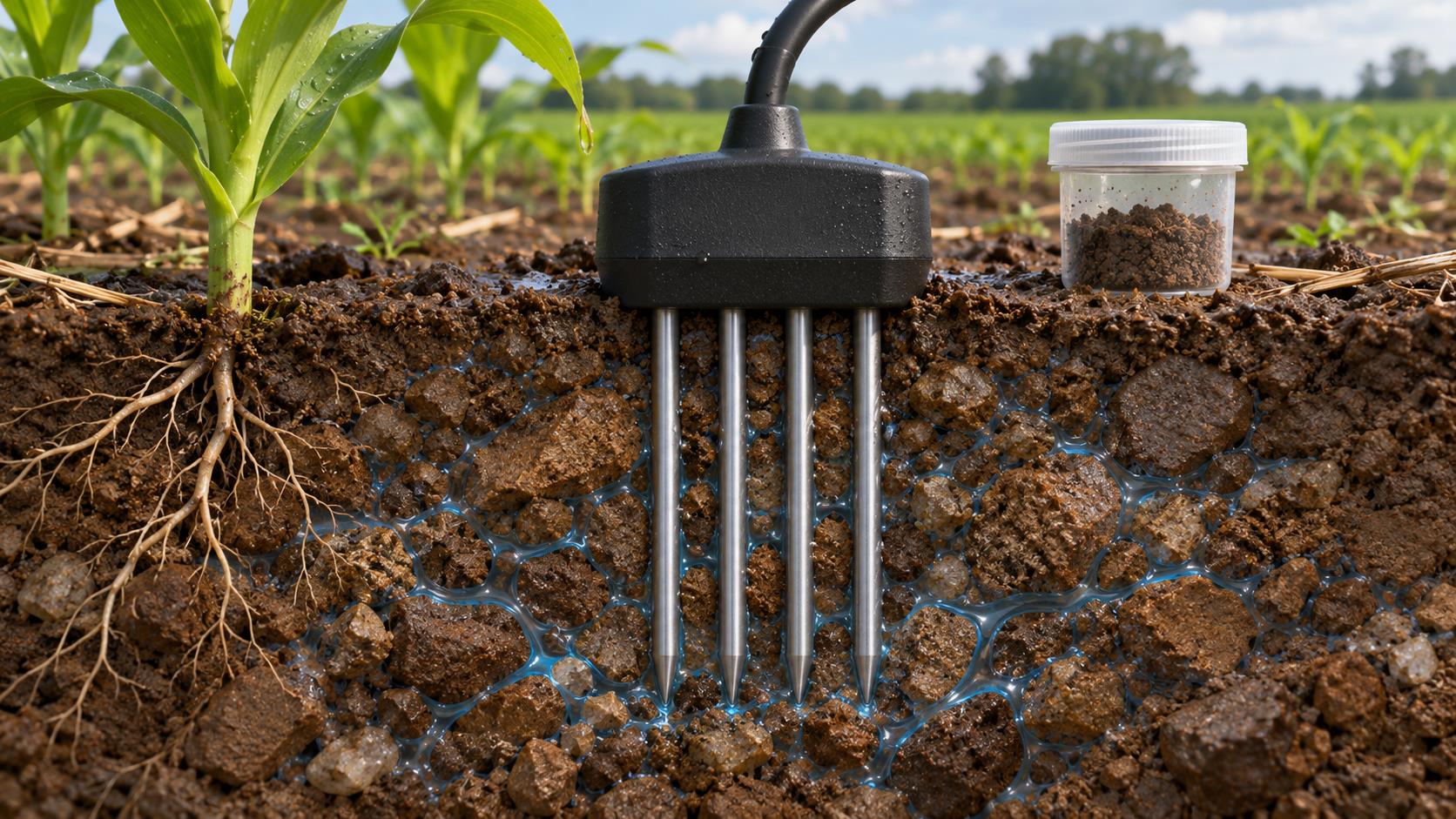
Water content changes the connected paths through which ions carry electrical current in soil. A bulk EC change after irrigation can therefore reflect changing moisture as well as changes in the soil solution. Do not interpret the trend as a direct change in salt concentration without further evidence.
Campbell's soil conductivity explanation describes this dependence. Pair EC with the available water-content series and the irrigation timeline. The soil moisture calculation guide helps identify the water-content basis used in those records.
Check temperature treatment and units
Determine whether the reported EC is measured at the current temperature or corrected to a reference temperature. Preserve the measured temperature and the documented correction method. Comparing a compensated series with an uncompensated one can introduce an apparent difference unrelated to field management.
Confirm units before plotting or exporting. METER's plant-response paper discusses units, temperature and model assumptions. Do not copy a correction coefficient from a different application without checking its validity.
Review placement and soil contact
Check that the installed probe samples the intended depth and management zone. Air gaps, disturbed backfill, stones and uneven wetting can affect what it experiences. Follow the actual model's insertion, contact and environmental requirements rather than assuming every probe sees a representative root-zone average.
Use the soil monitoring installation guide to plan depth, zones and installation records. Inspect sudden changes against handling or cable events before treating them as a new soil condition. Preserve the original location information when replacing a probe.
Treat bulk-to-solution conversion as a model
Converting bulk EC into pore-water or extract EC requires assumptions and additional information; it is not simply a unit conversion. Model suitability can depend on soil properties, water content and the range over which it has been checked.
Keep the model identity, inputs and validation evidence. A single universal multiplier is not a substitute for this record. Avoid extrapolating a model beyond its documented conditions merely because the calculated output remains numerically plausible.
Connect the data to a defensible decision
For a laboratory comparison, coordinate sampling depth, timing, preparation method and temperature basis. Use the method required by the interpretation or threshold. A nearby sample taken under a different condition may answer a different question from the installed sensor.
EC does not identify individual nutrients or establish a fertilizer dose by itself. Review the soil NPK measurement limitations guide when assessing broader soil claims. Seek a method-appropriate agronomic interpretation before changing irrigation or nutrient management on the basis of one value.
Frequently asked questions
Is bulk EC the same as laboratory extract EC? No. Confirm the laboratory preparation method and the sensor's reported quantity before comparison.
Why can bulk EC rise after irrigation? Moisture changes the conduction path, and the solution may also change. Interpret synchronized moisture, temperature and management records together.
Can EC reveal a specific nutrient concentration? EC reflects collective electrical conduction. It does not separately identify each ion or replace a method-specific nutrient analysis.