
Pyranometer vs PAR Sensor: Choose Energy or Photon Measurements
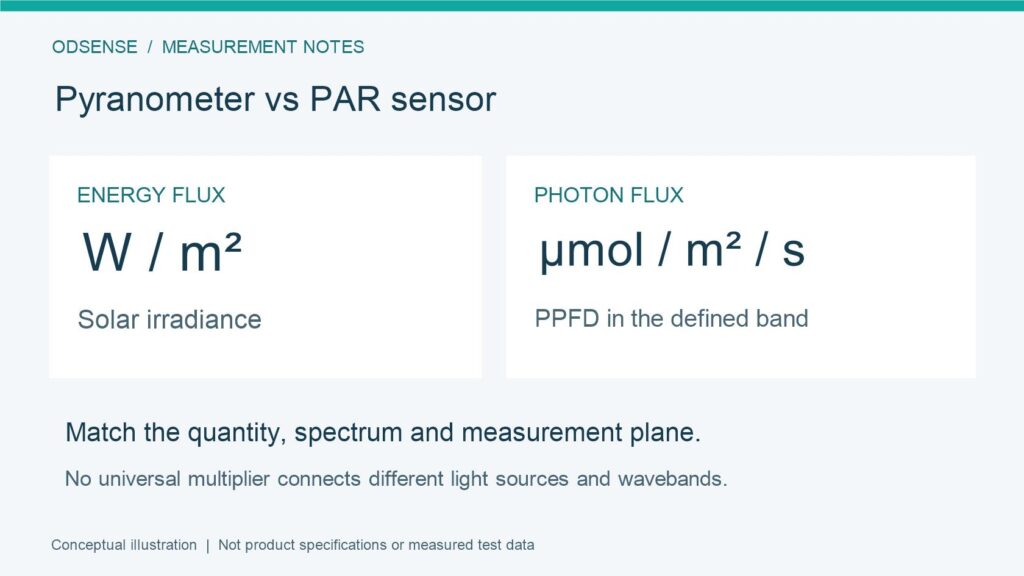
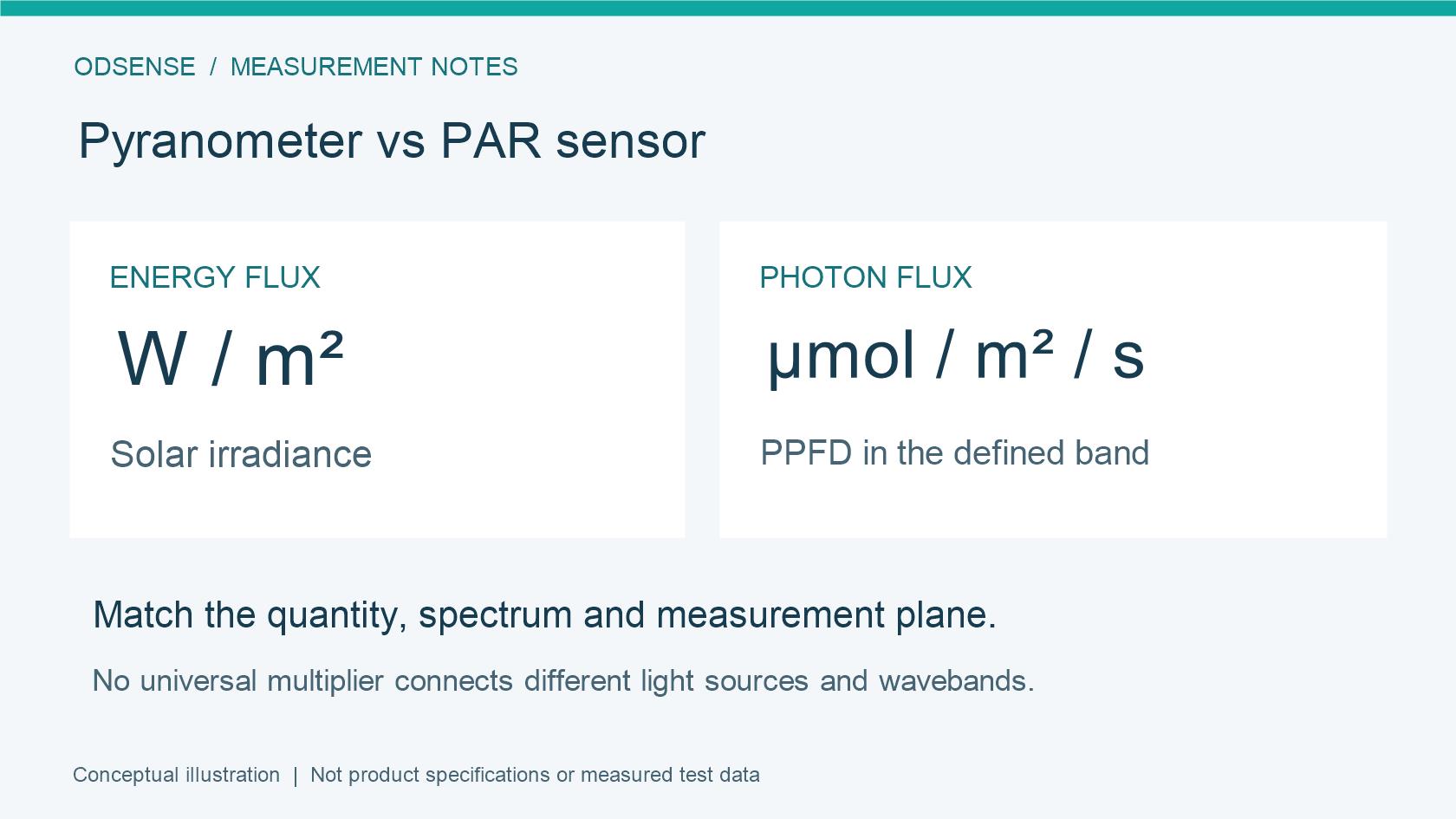
A pyranometer and a PAR sensor serve different measurement needs. A pyranometer reports solar irradiance as power per area, commonly W/m². A conventional quantum PAR sensor reports photosynthetic photon flux density, or PPFD, commonly µmol/m²/s. Choose the quantity needed for the decision before comparing output interfaces or prices.
Match the measurement to the decision
Use an appropriate pyranometer when the project needs shortwave solar irradiance for an energy or meteorological assessment. Use an appropriate quantum sensor when the project needs incident photon flux in its specified photosynthetic band. A greenhouse may need both because energy entering the structure and photons reaching a crop are separate questions.
The LI-COR radiation-sensor comparison distinguishes these quantities and units. For the wider planning context, see the agricultural light-sensor guide. A shared communication protocol does not make the measurements interchangeable.
Read the spectral response rather than the product label
Conventional PAR is commonly associated with the 400–700 nm band. Check whether a proposed device measures that band or an extended band, and record the definition with the channel. Products marketed for different photon bands should not be compared as if they had identical boundaries.
Pyranometers also differ. Silicon and thermopile designs do not have identical spectral responses, and the manufacturer's calibration and application limits matter. Apogee's pyranometer overview explains that distinction. Do not apply one model's waveband or accuracy statement to all solar-radiation sensors.
Avoid a universal W/m²-to-PPFD multiplier
Energy per photon depends on wavelength. A conversion between energy flux and photon flux therefore depends on the source spectrum and the bands being compared. A factor developed for a particular daylight condition is not automatically valid for a different lamp, glazing system or spectral filter.
The Apogee quantum-sensor manual explicitly requires source spectral information for conversions to other quantities. If a project uses an estimated conversion, label the derived channel, document its assumptions and validate its suitability. Do not present the estimate as an independent sensor measurement.
Specify the measurement plane and surroundings
An outdoor horizontal irradiance measurement and a crop-plane measurement inside a greenhouse do not represent the same exposure. Record sensor height, orientation, shading, nearby structures and whether the reading is above or within a canopy. A tilted measurement plane must be identified rather than silently mixed with horizontal data.
Keep the sensing surface clean and use the installation method specified for that model. The pyranometer cleaning and leveling checks explain why installation condition belongs in the measurement record. A clean outdoor reference cannot by itself establish uniform light distribution across a crop bed.
Preserve units when logging and integrating
Record the instantaneous quantity, sampling interval, averaging period and any integration method. W/m² is an irradiance, while an accumulated energy value requires time integration. Similarly, PPFD and a daily photon integral are different data products. Missing samples and inconsistent time bases can distort accumulated results.
Confirm the transmitter scaling and unit labels all the way to the dashboard. Retain sensor model and calibration information so that a replacement does not silently change the meaning of a channel. Include these details in the wider greenhouse measurement plan.
Use a clear procurement example
Consider a greenhouse project that needs outside solar loading and an inside crop-light record. Specify the outside irradiance quantity and plane independently from the crop-level PPFD measurement. Then verify environmental suitability, source response, placement and logging requirements for each device. A single sensor may be insufficient even when a controller can display both kinds of units.
Frequently asked questions
Can a lux sensor replace a PAR sensor? Not as a general substitution: lux weights light for human visual response, while PPFD counts photons within a defined band.
Is every PAR sensor suitable for every LED source? Check the specified spectral response and source-related error for the proposed model.
Should the two sensors show the same number? No. They measure different quantities with different units and potentially different exposure conditions.