
Greenhouse Sensors: Planning Measurements Before Choosing Hardware
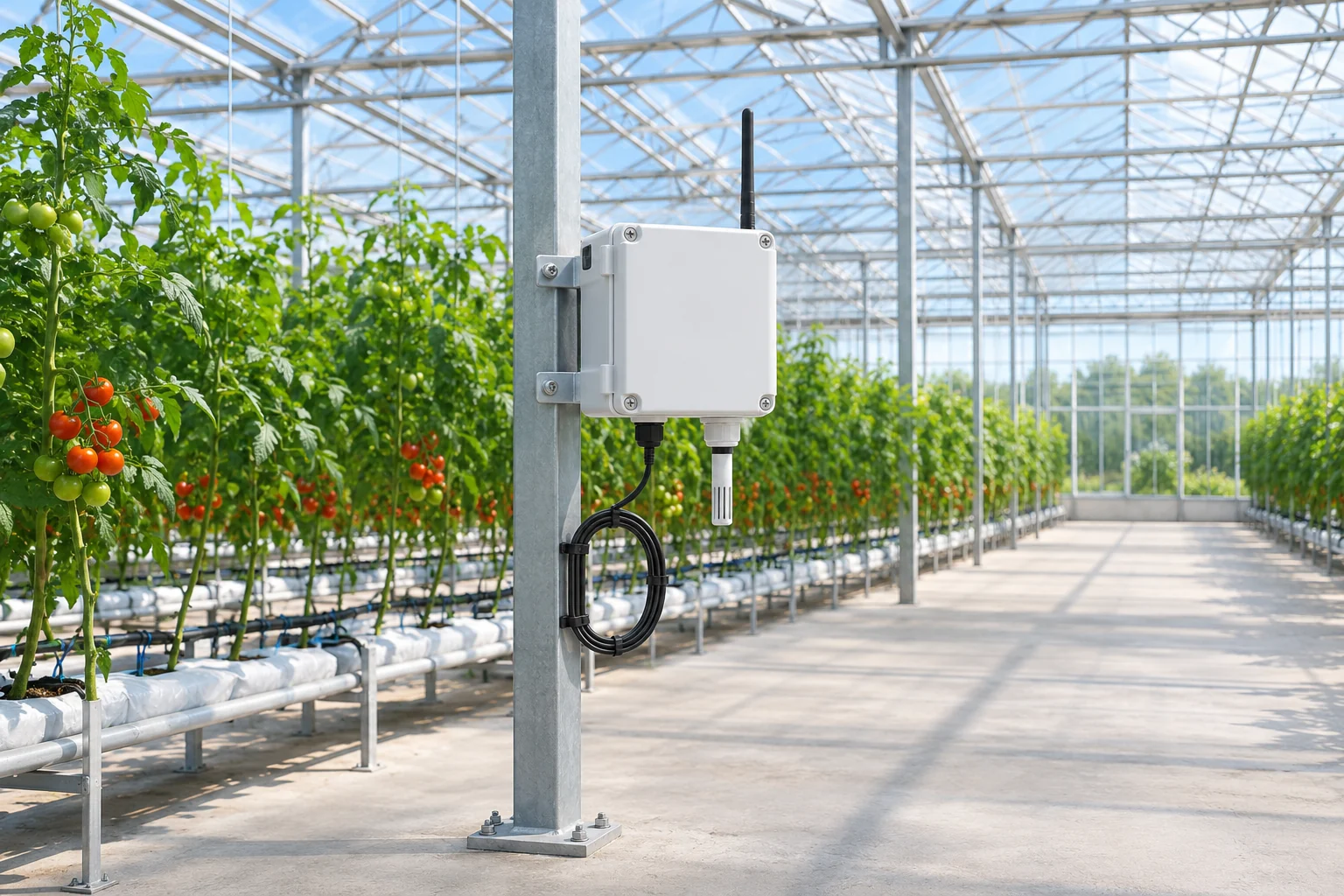
Greenhouse sensors are most useful when each measuring point supports a clear growing or operating decision. Begin with the decisions and zones, then choose the measurements, installation and data path. A long list of channels is less useful than a small set of well-defined, maintainable measuring points.
Separate crop-air measurements from root-zone measurements
Write two lists: conditions around the crop canopy, and conditions in the rooting medium. Record what the operator intends to do with each reading. A temperature value in an equipment enclosure should not quietly become the reported crop-air temperature, and a soil probe should not be described as an air-humidity sensor.
| Project question | Information to record | Confirmation needed |
|---|---|---|
| How does the crop zone vary? | Growing zones, canopy position and operating routines | A representative placement plan rather than one universal mounting height |
| What is happening around roots? | Soil or substrate, probe depth and irrigation arrangement | Probe suitability and interpretation for that medium |
| What does a CO2 reading support? | Measuring location and intended operating decision | Correct range, setup and reference procedure |
| Who acts on a reading? | Responsible operator and required reporting interval | Data delivery and a separately tested alarm or control arrangement |
Survey locations before specifying the final quantity
Draw the proposed positions on a simple greenhouse plan. Include doors, heaters, fans, irrigation lines and the points staff can reach for service. Ask whether a proposed reading represents an operating zone or only a convenient mounting location. Keep enough location information to repeat the assessment after the crop layout changes.
For root-zone work, record installation depth, probe orientation and the material surrounding the probe. Compare only readings taken under a documented arrangement. If multiple crop zones require different interpretation, keep their records separate rather than averaging them into a number with no clear operating meaning.
Specify the complete measurement path
Separate the sensor, power supply, communications equipment and receiving software in the bill of materials. Request the actual output configuration for each item. Wired and wireless options need their own integration documents; an optional radio does not automatically include a gateway, network service or control platform.
Use a small pilot to test timestamps, units and the identity of each measuring point. Ask the operator to find an old reading, recognize a missing one and identify the sensor responsible. These practical tasks expose requirements that a catalog comparison can miss.
Agree acceptance and service responsibilities
- Define the conditions and reference method used during incoming checks.
- Record each sensor identifier, position and configuration revision.
- Assign cleaning, verification and replacement responsibilities.
- Test the intended response to a disconnected sensor before depending on its data.
- Document unresolved configuration choices before placing a larger order.
Review the greenhouse CO2, temperature and humidity sensor alongside the soil sensor selection information when preparing a project-specific specification. Confirm the actual model, fitted options and integration documents before ordering.
Frequently asked questions
Does a greenhouse need every available sensor?
No. Select measurements that support a defined decision and can be installed and maintained appropriately.
Does a sensor package include automatic climate control?
Only if a complete, documented control arrangement is specified. Measurement channels alone do not establish control functions.