
NTU vs FNU Turbidity: Compare the Method Before Joining Data
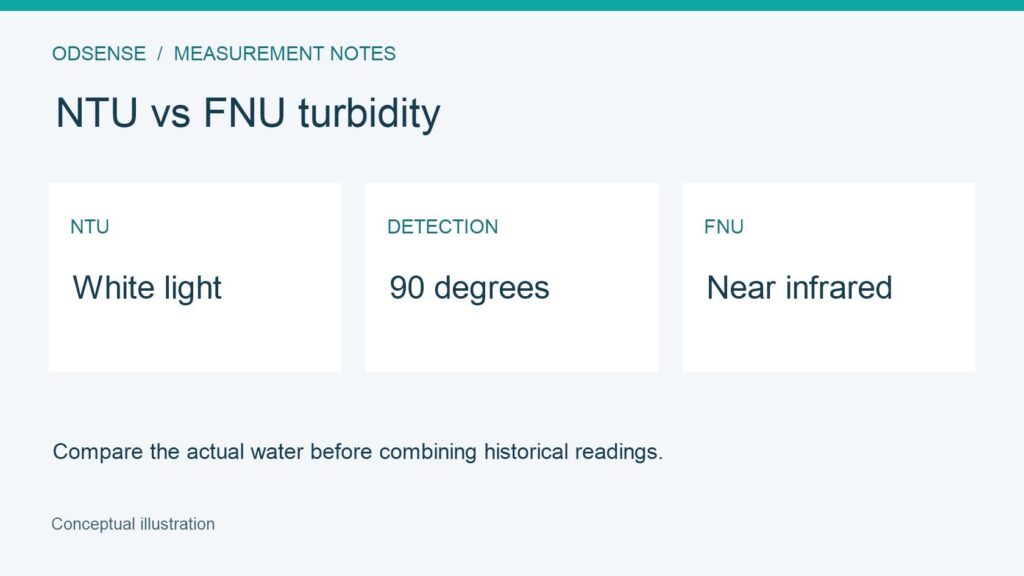
An NTU vs FNU turbidity comparison starts with the two optical methods. Standard solutions can give closely matching values, while natural water samples can behave differently across instruments. When replacing a sensor, check its light source, detector configuration and sample results before continuing an existing trend or reusing an alarm setting.
Read the optical method behind the unit
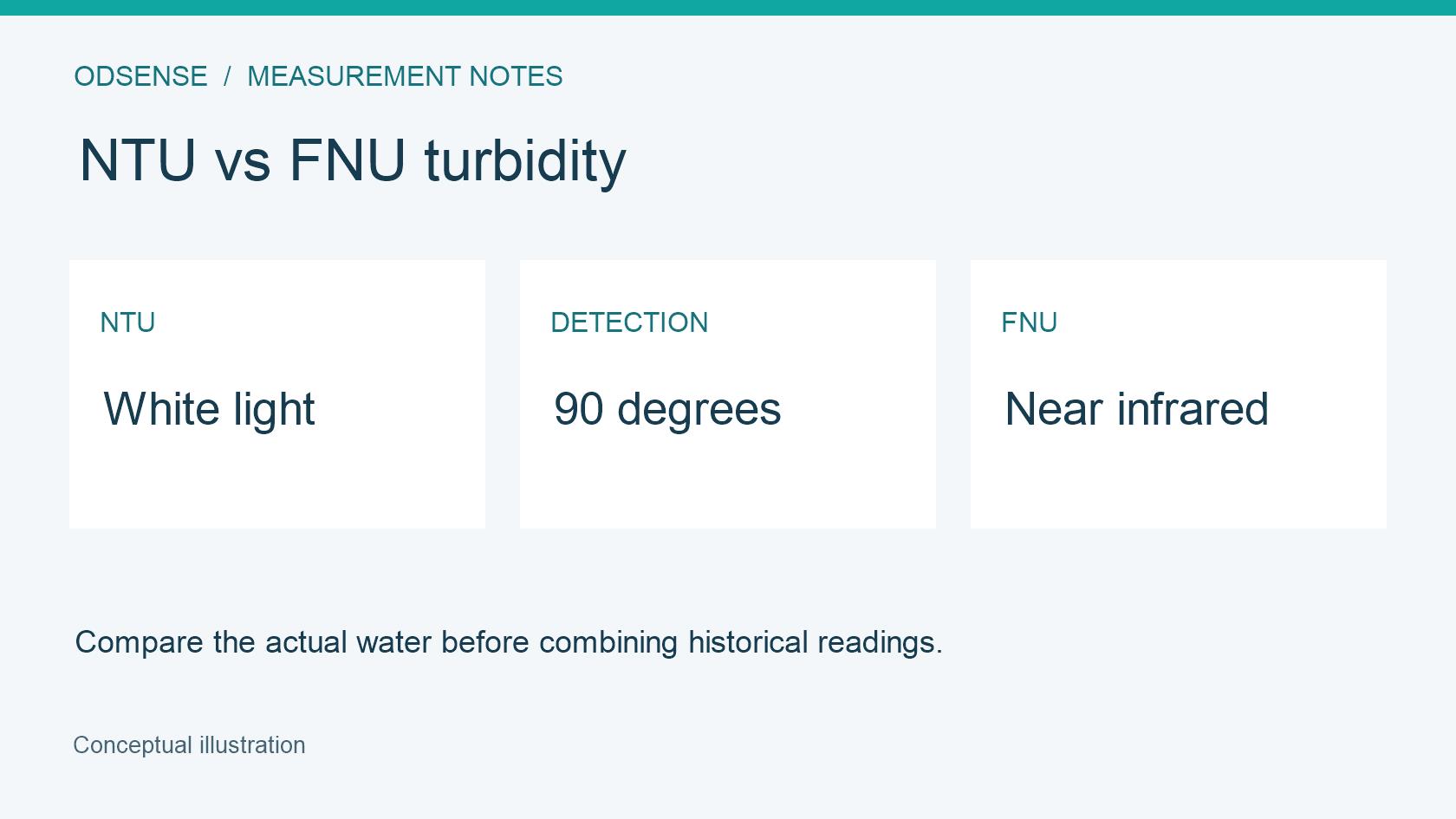
In the USGS reporting definitions, NTU is associated with white or broadband light and 90-degree detection, while FNU uses near infrared or monochromatic light and 90-degree detection. Method definitions also distinguish other arrangements, including ratio instruments. Start with the actual model and operating mode. The turbidity measurement guide explains how scattering is used to describe water clarity.
Distinguish calibration agreement from sample agreement
Measurements of a calibration suspension can agree even when two instruments respond differently to water from the same site. Optical response can vary with the suspended material and sample color. Health Canada's method discussion describes the difference between comparison on a calibration solution and measurement of a water sample. Avoid applying a universal numerical conversion.
Confirm what a display option changes
Check whether changing a unit on the transmitter changes the calculation, the optical mode or just the label. A California DWR reporting memo describes specific instruments where switching the displayed label did not change the value. That finding applies to the equipment evaluated in the memo. For a replacement, record the model, firmware, stated method and selected reporting mode.
Run a paired comparison before changing sensors
Where feasible, operate both instruments on comparable samples or side by side during a crossover period. Capture a representative portion of the working range and the conditions that influence the measurement, such as a change in suspended material after rainfall. Record paired timestamps, sample point, units, sensor cleaning and quality flags. If using grab samples, coordinate timing and handling to limit changes from settling or bubbles.
Plot the paired results and review whether any difference changes with sample conditions or reading level. A match at a single calibration point does not establish agreement in the field.
Keep historical trends and alarms traceable
Mark the instrument change in the data record. Preserve original values and units. If a project adopts a site-specific relationship supported by paired readings, document where it applies and retain the original channels. If the relationship is uncertain, display the two series with a clearly marked transition. Verify alarms on the new measurement basis before use.
Include installation and data fields in procurement
Request the supported methods, measurement ranges, calibration instructions, installation constraints and the unit information available from the output. The turbidity sensor and transmitter guide covers hardware choices. Follow the signal through to the dashboard to verify its engineering units. For analogue installations, use the 4–20 mA loop checks to help rule out a scaling mismatch.
Frequently asked questions
Can one NTU always be treated as one FNU? Agreement on a standard is not evidence of a universal relationship for field samples. Compare the methods and the actual water.
Should older records be relabeled? Relabeling requires evidence that the previous label did not describe the instrument's actual method. Keep an audit record of the correction.