
Daily Solar Radiation from a Pyranometer: Convert W/m² to MJ/m²
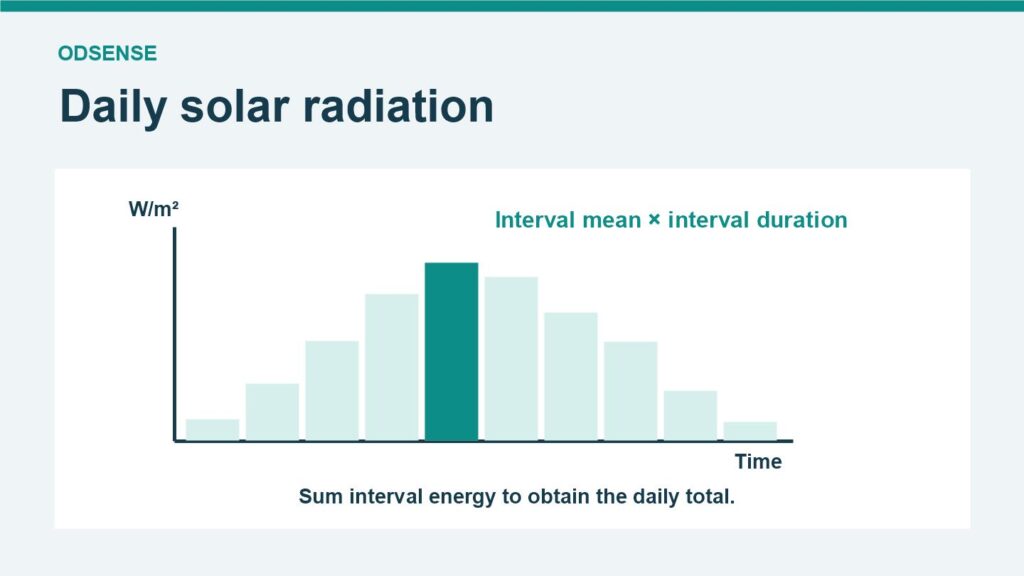
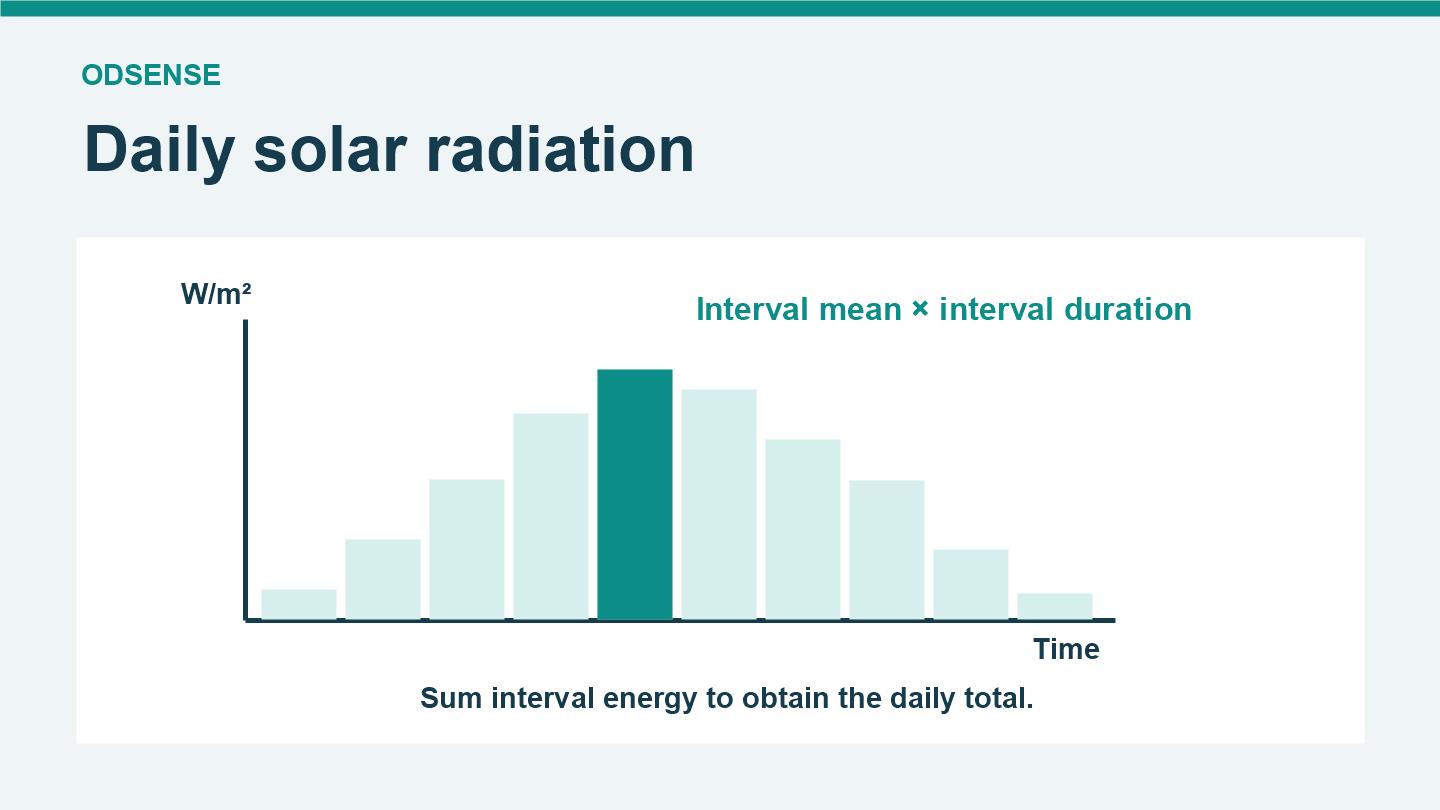
To calculate daily solar radiation from a pyranometer, multiply each interval's mean irradiance in W/m² by the interval length in seconds. Add the results and divide by 1,000,000 to get the day's energy in MJ/m². Before doing the calculation, confirm whether the data logger exports interval averages, individual samples, or energy totals.
Identify what each record represents
A value in W/m² tells you the irradiance at an instant or its average over an interval. A value in MJ/m² tells you the energy received per unit area over a period. The Campbell Scientific pyranometer manual shows separate logger outputs for average irradiance and total energy. Use the data logger sampling interval guide to distinguish measurement frequency from storage frequency.
Convert interval irradiance to energy
One watt equals one joule per second. In a worked example, an average of 600 W/m² over 15 minutes represents 600 × 900 = 540,000 J/m², or 0.54 MJ/m². Convert each valid interval using its own duration and add the results. With only instantaneous samples, integration requires an approximation whose accuracy depends on the sampling pattern and changing sunlight.
Set the day boundary before adding the intervals
Pick the reporting time zone and document whether each timestamp marks the start or end of its interval. For example, a record labeled 00:00 may represent the last interval of the previous day. Convert timestamps before grouping data. If a reporting boundary falls inside an interval, split the energy proportionally only if that approximation suits the application.
Flag incomplete days and gaps
Check the number and duration of valid records against the expected coverage. Distinguish a valid nighttime value from a missing daytime value. Never extend the preceding average across a data gap just because two successive timestamps are far apart. Keep the partial total and mark it incomplete, or document an approved method and flag the intervals it estimated.
Avoid integrating the same energy twice
Some instruments provide integrated daily energy directly. The Apogee MP-100 documentation is one example. Sum per-interval energy if that is what the export contains. For a cumulative counter, use differences, accounting for resets and rollovers. A complete 24-hour average of 200 W/m² corresponds to 17.28 MJ/m². FAO's meteorological data chapter gives the same factor of 0.0864 for a full 24-hour mean.
Check the signal before accepting the daily total
Unexpected daytime dips can come from shade, a dirty dome, or a real cloud passage. Review the irradiance trace and the pyranometer maintenance guide. Keep the measurement plane in the record. A horizontal reading and a panel-plane reading describe different surfaces. For plant-light measurements, see the pyranometer and PAR sensor comparison.
Frequently asked questions
Can I multiply a daylight-only average by 0.0864?
Use the duration actually represented by the average. The factor 0.0864 applies to 86,400 seconds. A daylight-only average represents a shorter period.
How do I convert MJ/m² to kWh/m²?
Divide MJ/m² by 3.6. For example, 18 MJ/m² equals 5 kWh/m² over the same period.