
Dew Point vs Frost Point: Which Reading Applies Below Freezing?
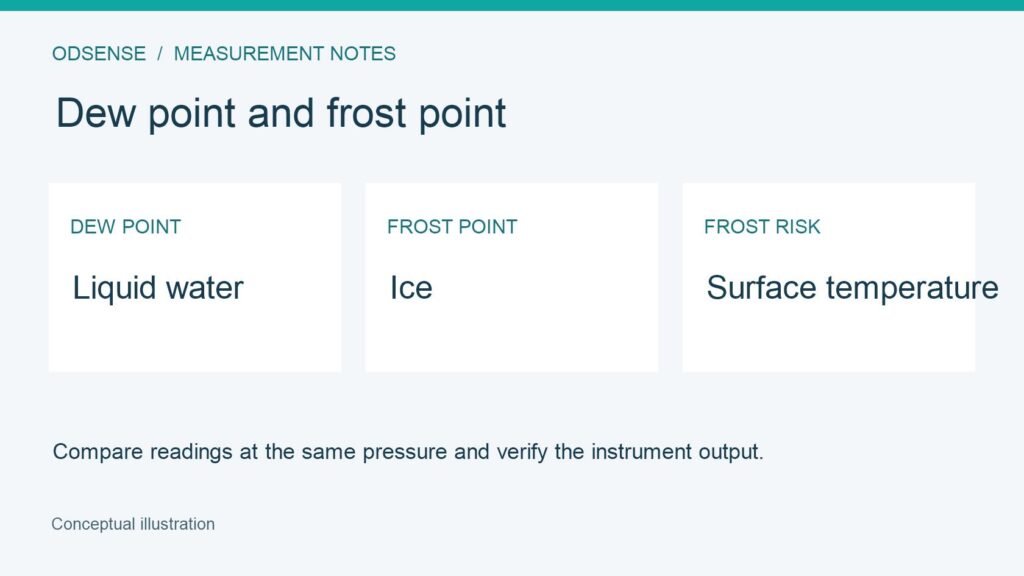
Dew point is defined by equilibrium with liquid water. Frost point uses equilibrium with ice. When comparing dew point vs frost point below freezing, confirm the phase reference and the measurement pressure. Two displays labeled “dew point” can report different quantities even when they sample gas with the same water vapor content.
Start with the phase reference
For a given water vapor partial pressure, use the saturation curve over liquid water to find the dew point. Use the curve over ice to find the frost point. When both points are below freezing, the frost point is higher than the dew point based on supercooled water. The Vaisala humidity instrument note explains why the two can differ.
The dew point monitoring guide explains the broader relationship between moisture and condensation.
Read the output definition in the instrument manual
Check whether the reported parameter is dew point over water, frost point over ice or a combined output whose phase basis switches at a stated temperature. A controller tag or short display label can omit that distinction. Confirm the selected output and its definition before comparing data from different sensors. The Vaisala dew and frost point selection note illustrates the need to identify the output.
Compare with the relevant surface temperature
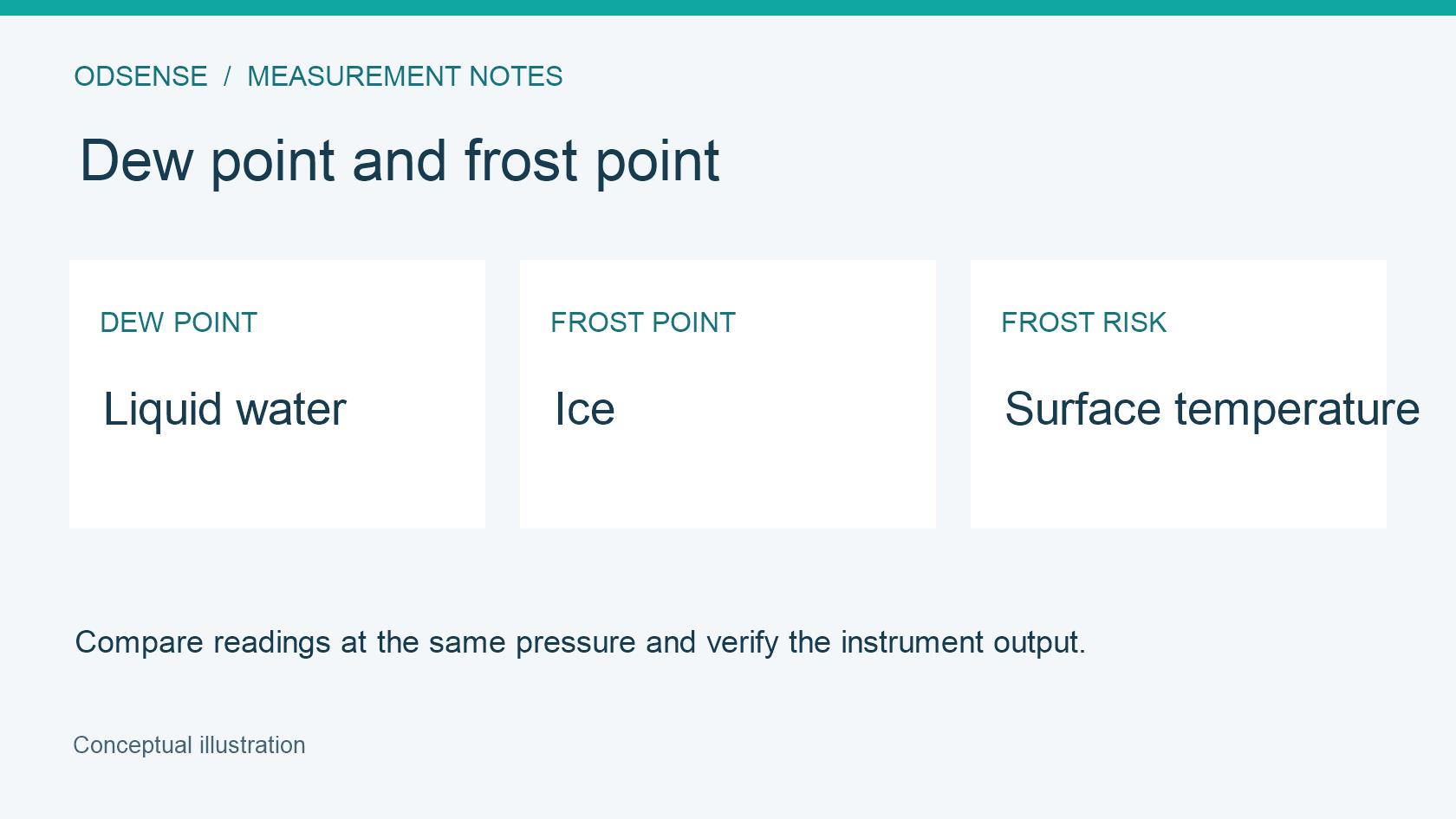
For frost risk on a cold surface, compare its measured or estimated temperature with the frost point of the gas at that location. A warmer bulk gas temperature can coexist with a colder surface. Record where both readings are taken, especially around inlet air, refrigeration coils or thermal bridges.
The comparison indicates when local equilibrium favors ice formation. It does not establish the exact rate of buildup. Air movement, surface conditions and existing moisture can change what is observed.
Match the pressure when comparing gas readings
In compressed gas, the water vapor partial pressure changes when total pressure changes at the same vapor mole fraction. A reading at line pressure can therefore differ from a reading taken after pressure reduction. Check whether each value is measured or corrected to a specified pressure.
For calculated outputs, the Vaisala HMP155 manual gives an example of an instrument’s dew and frost point calculation under its stated conditions. Use an approved method for the pressure and phase range in your application. The dew point transmitter guide discusses the sampling choices.
Make an alarm rule traceable
Define whether the alarm is based on moisture in the gas or the risk at a particular surface. Record the phase reference, pressure basis, units and the location of the cold surface. Choose the margin using the required process conditions, instrument uncertainty and response time. Avoid copying a threshold to a different output without verifying its definition.
Verify the output before comparing historical data
Confirm the displayed label, transmitted units and data tag at the sensor and controller. For a replacement, record the previous and new conventions and mark any change in the trend. If a humidity probe was wetted, follow the condensation recovery guide before interpreting it as a stable measurement.
Frequently asked questions
Can a negative dew point be reported over water? Yes. Check the instrument’s phase convention before interpreting a value below freezing.
Can I transfer an alarm to another dryer or sampling line? First compare the pressure, output convention and requirement at the point the alarm is meant to protect.