
Humidity Sensor Condensation: Recovery and Reading Checks
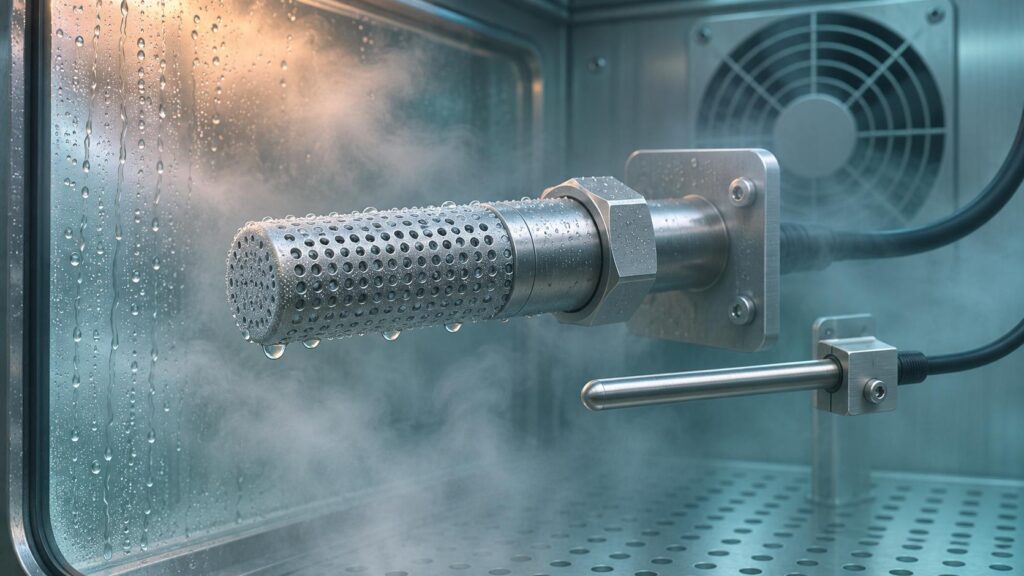
Humidity sensor condensation can make readings unreliable until the sensing assembly recovers. Treat an unexpected high or slow-changing value after wetting as a measurement event to investigate. Record the environmental conditions, follow the model's approved recovery instructions and verify the result before changing calibration coefficients or using the channel for a control decision.
Separate saturated air from a wet sensor
A high relative humidity reading can describe real air conditions. It can also occur while liquid water on a sensor or filter interferes with the measurement. A cold probe introduced into warm humid air may be below the local dew point even when the surrounding air is not saturated.
Vaisala's condensing-environment discussion explains how probe temperature and installation can create wetting. The dew point monitoring guide provides the underlying temperature relationship. A flat high reading alone does not identify the cause.
Preserve the event before changing settings
Keep humidity, temperature, timestamps, channel status and recent handling or cleaning records. Note fog, spray, rapid temperature transitions, enclosure opening and power interruptions. Check whether the logger stored a live measurement, a held last value or a fault substitute during the event.
Record what happened before and after the reading changed. If a controller smooths values, retain the available unsmoothed record as well. Replacing suspect values with plausible numbers hides the event and makes later comparison harder. Flag uncertain data according to the project's data-quality rules.
Follow the approved recovery method
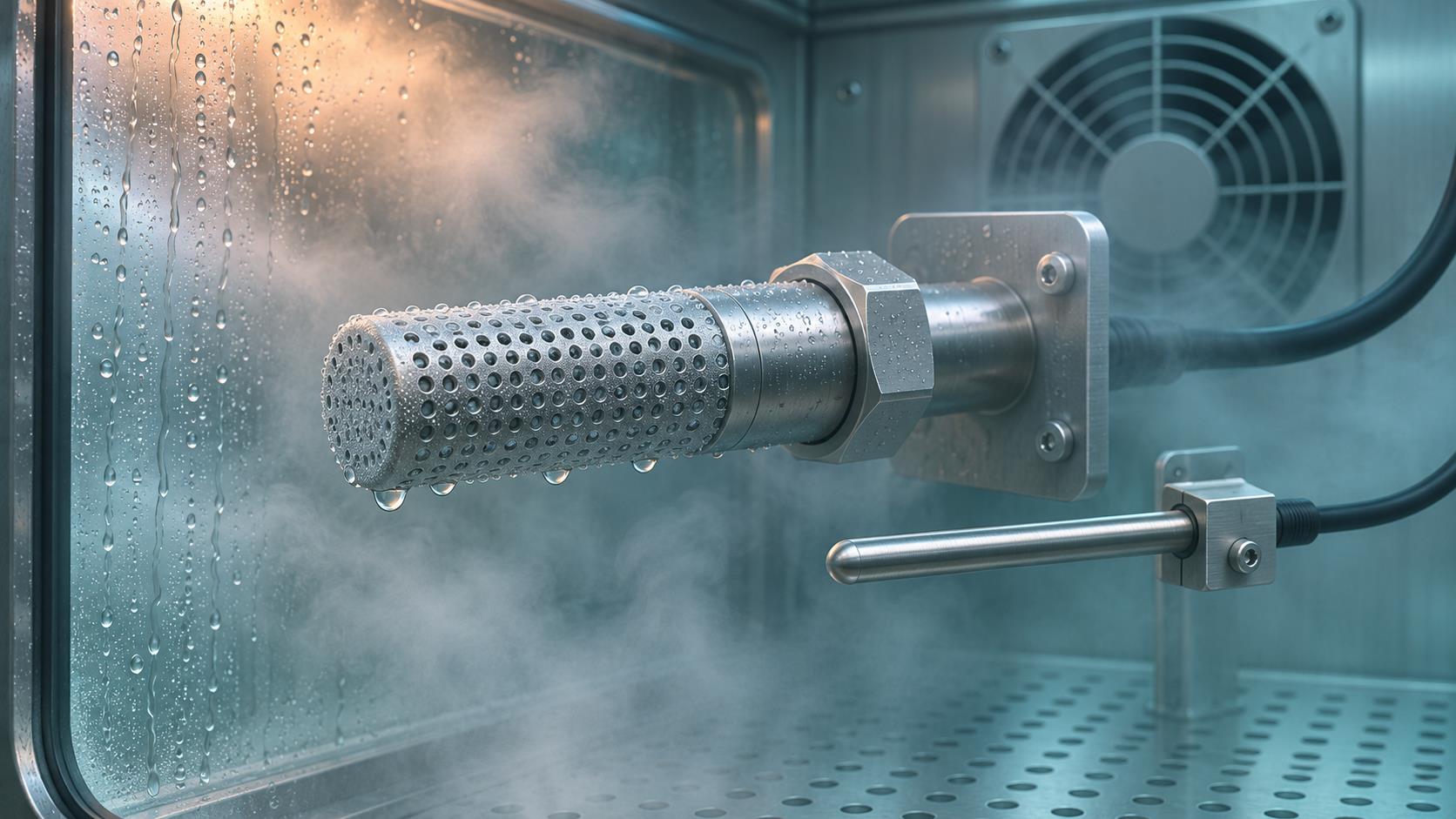
Consult the specific probe manual for permitted drying, filter handling and cleaning. Allow the sensing assembly to equilibrate in a suitable environment before assessing its response. Do not use a heat gun, solvent or compressed-air jet unless the manufacturer explicitly permits that method for the assembly.
Condensation tolerance does not establish a universal recovery time. Contaminated water can leave residues, and damage or contamination may require service rather than extra waiting. Inspect connectors and the filter using the approved access procedure. Avoid touching or wiping the sensing element itself.
Check temperature and location together
After apparent drying, compare both temperature and humidity under stable, representative conditions. Heat conducted through a wall, nearby electronics, sunlight or a cool mounting surface can bias the local condition experienced by the probe. Two instruments in different microclimates are not an independent calibration check.
The industrial temperature and humidity selection guide helps assess placement and environmental requirements. A temperature mismatch can explain a humidity disagreement without proving either humidity element needs an offset adjustment.
Treat probe heating as a model-specific feature
Some instruments include preheating, intermittent sensor heating or continuously warmed probes. These functions have different purposes and may interrupt measurements or require a separate ambient temperature input to calculate ambient relative humidity.
The HM70 preheat instructions and Vaisala's high-humidity instrument guide illustrate product-specific approaches. They do not establish that another probe has these capabilities. Confirm the supported mode, output behavior and status flags in the actual model documentation.
Define a return-to-service check
Use an appropriate comparison instrument or approved reference method after conditions stabilize. Agree the acceptance criteria from the application requirements and instrument documentation. Check response over a relevant change in conditions where practical, rather than accepting one matching display value as proof of full recovery.
Document the event, recovery action, comparison conditions and any remaining uncertainty. Persistent disagreement warrants further inspection or calibration service. Review the humidity accuracy evidence guide before interpreting a datasheet accuracy number as a guarantee of installed performance after wetting.
Frequently asked questions
Does a high reading prove condensation? No. Air conditions, probe temperature, liquid water and contamination must be considered together.
Can every humidity probe be heated to recover? No. Use only a documented feature or approved method for the specific sensor. Improvised heating can damage the assembly or alter the measurement.
Should I recalibrate immediately after a wet event? First investigate the cause, complete approved recovery and compare under stable conditions. Calibration changes made while the probe is wet can conceal the original problem.