
Relative Humidity vs Absolute Humidity: What Changes When Air Warms?
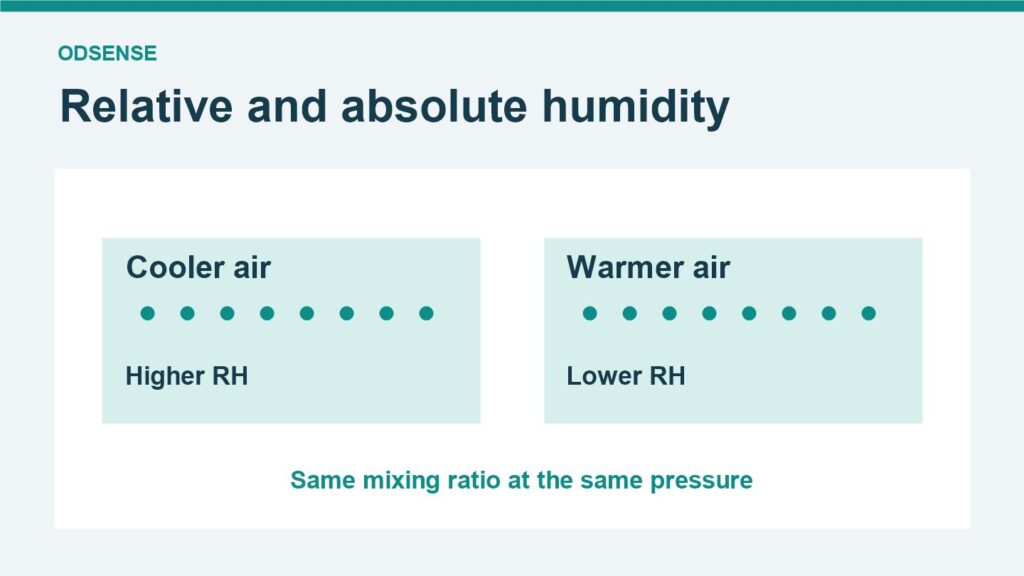
When comparing relative humidity vs absolute humidity, check the meaning and unit first. Relative humidity describes how close the air is to saturation at its current temperature. Absolute humidity in g/m³ describes water vapor mass per volume. To compare how much moisture moving air carries before and after heating, use the mixing ratio in grams of water per kilogram of dry air.
Which quantities describe moisture in air?
Relative humidity is the ratio of actual vapor pressure to saturation vapor pressure at the same temperature, expressed as a percentage. Absolute humidity on a volume basis is typically expressed in g/m³. Mixing ratio uses dry-air mass as its basis. Vaisala's humidity application note defines these measurement quantities.
Why heated air can show a lower RH
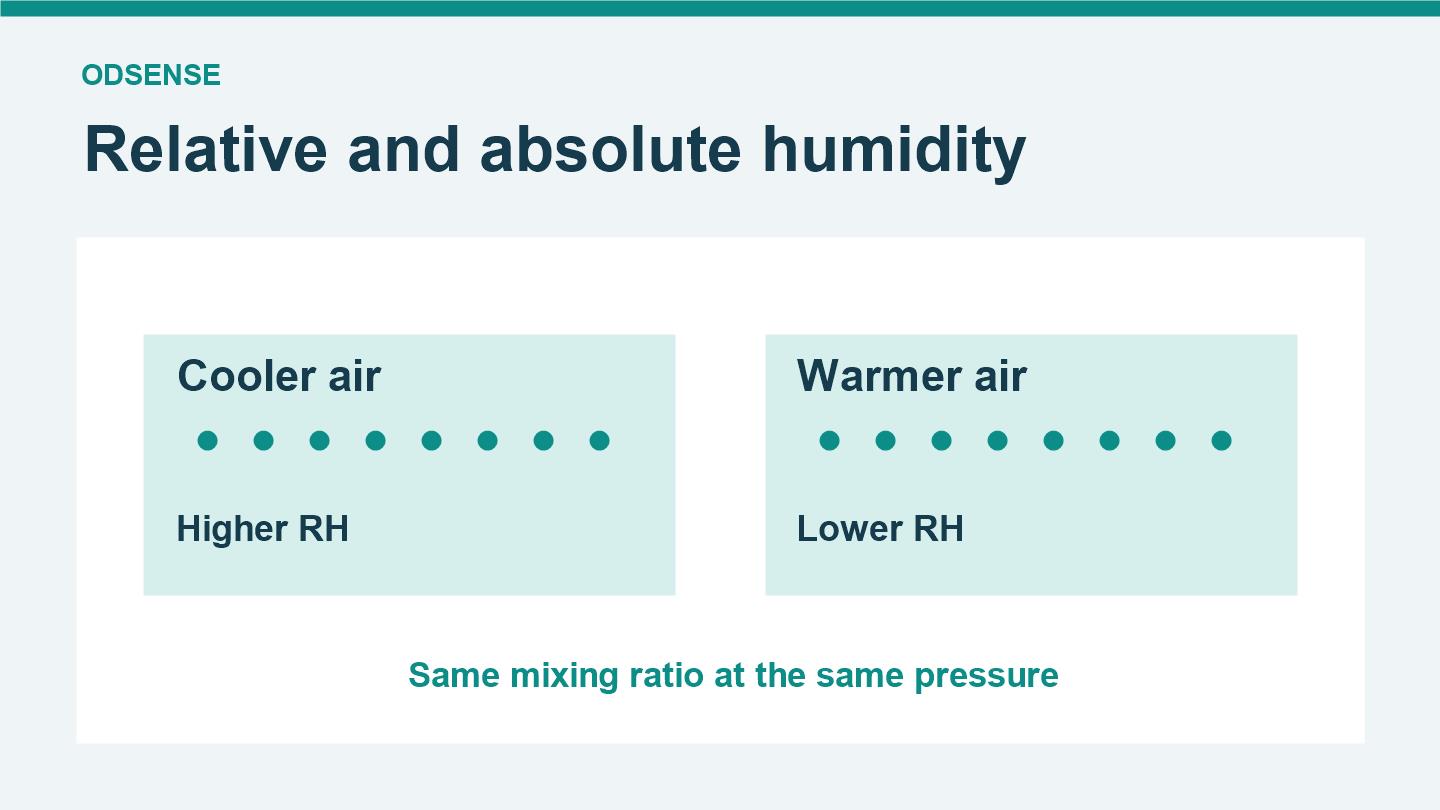
In a duct operating at roughly constant pressure, a heater can warm the air without adding or removing water. Saturation vapor pressure rises, so RH falls. The mixing ratio stays approximately constant and the dew point stays approximately constant at the same pressure. Absolute humidity in g/m³ can change because the warmed air occupies a different volume per unit mass.
Choose the reading that answers the question
Use RH to monitor conditions defined by a temperature-dependent humidity limit. Use mixing ratio for a moisture balance. To check condensation on a cool surface, compare its temperature with the dew point of the adjacent air. The National Weather Service dew point guide explains dew point at constant pressure. The condensation monitoring guide covers the surface comparison.
Compare ventilation air using the same basis
Outdoor air can report a higher RH while carrying less water per kilogram of dry air than indoor air. Compare mixing ratios at the appropriate pressures when evaluating whether outdoor air would add or remove moisture. The final indoor result also depends on airflow and indoor moisture sources. Vaisala's humidity equations show where pressure enters the calculation.
Check temperature and RH at the same point
Take temperature and RH readings from the same air stream at the same time. A warm probe housing, direct sun, or a nearby supply jet can make the measured conditions differ from the zone of interest. Check the industrial temperature and humidity monitoring guide when choosing and documenting sensor locations.
Log the raw values and calculation settings
Keep measured temperature and RH alongside derived values. Record the pressure used for calculations, the intended units, and any fixed-pressure assumption. When a trend changes after firmware, controller, or logger work, compare the settings as well as the air conditions. The humidity sensor accuracy guide discusses why the relevant operating conditions matter.
Frequently asked questions
Can I convert RH to g/m³ without air temperature?
You need the temperature to obtain saturation vapor pressure and to calculate vapor density. Use RH and temperature from the same location and time.
Does falling RH prove that a dehumidifier removed water?
Warmer air can also show a lower RH. Compare the mixing ratio or the dew point at comparable pressure before and after the system operates.