
PM2.5 Sensor Humidity Effects: Investigating High Readings
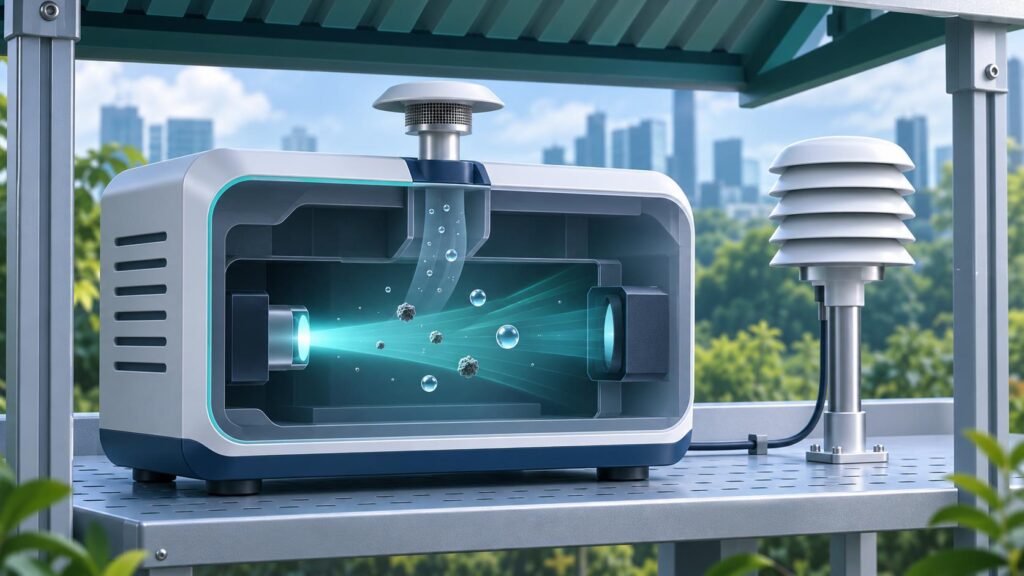
PM2.5 sensor humidity effects can complicate the interpretation of a high particle reading. Optical sensors estimate particulate concentration from light interacting with sampled particles. Moisture can change that response, but a rise during humid conditions is not automatically false. Preserve the observations and investigate the measurement chain before deciding what the event means.
This guide is for air-monitoring integrators and facility teams reviewing indicative sensor data. It provides a practical investigation sequence. It does not turn an informational monitor into a regulatory reference instrument or establish a universal humidity cutoff for every model and aerosol.
Understand what an optical PM value represents
A compact optical sensor typically detects light scattering and uses an algorithm to estimate particle-related outputs. Converting that signal to mass concentration involves assumptions about the particles and instrument design. Different aerosols can therefore produce different relationships between optical response and mass.
PM2.5 is a particle-size-related reporting category, not a chemical identification. A display cannot by itself tell the operator which substance caused a rise. The PM2.5 measurement introduction explains the underlying quantity and why the measurement method and context must accompany a reported value.
Treat humidity as a potential influence, not a complete diagnosis
Some particles take up water as relative humidity increases, changing their size and optical properties. At high moisture levels, mist or fog can also influence an optical response. EPA's PM sensor testing guidance discusses humidity as an environmental performance factor that should be evaluated for the intended monitoring use.
The effect depends on the sensor, aerosol and sampling arrangement. Avoid applying a single humidity limit or correction coefficient from another device as a universal rule. Humid conditions and a real particle event may occur together. The useful question is whether the available evidence supports the reading under those specific conditions.
Preserve synchronized humidity and temperature records
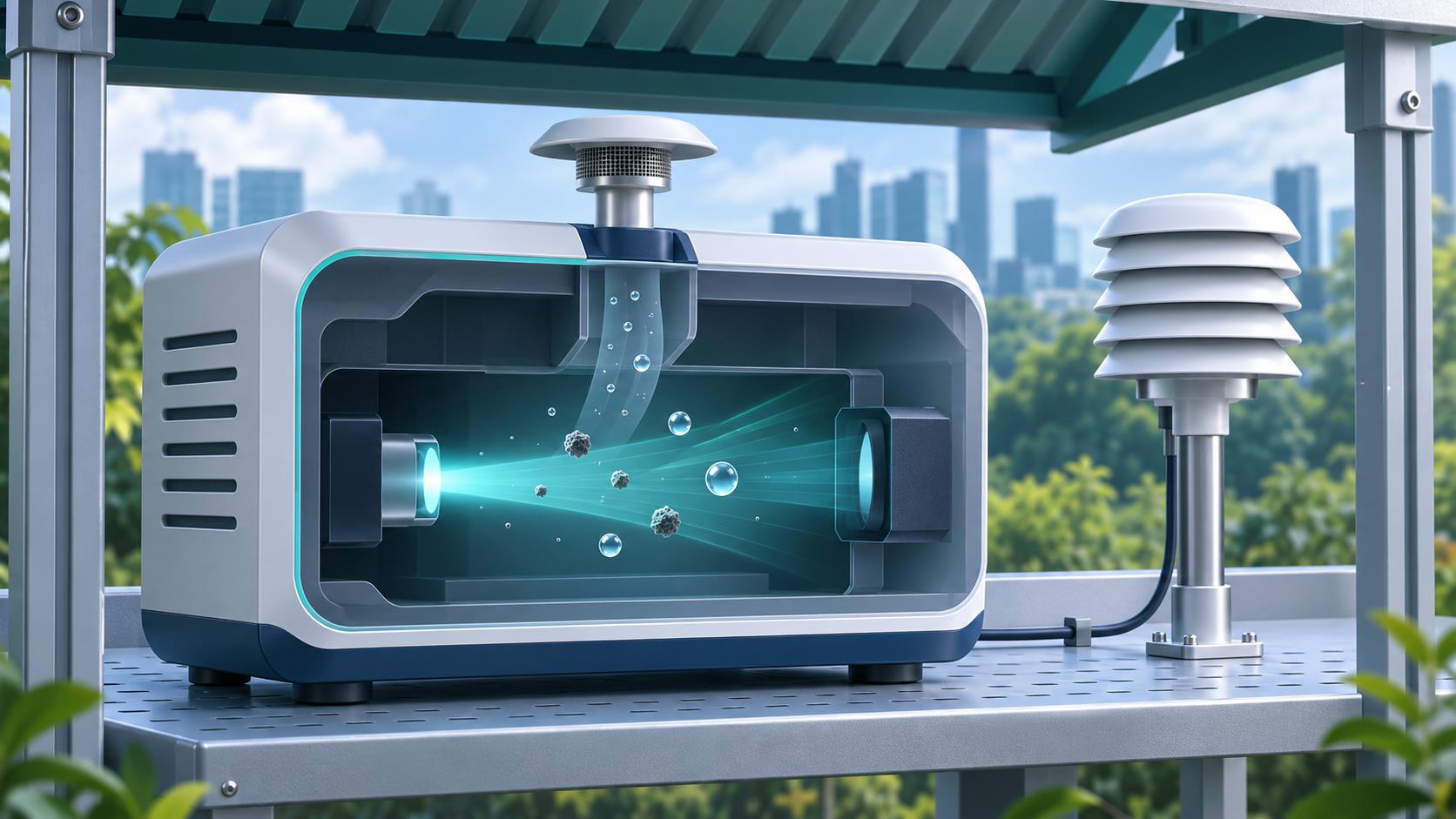
Store particle values, relative humidity, temperature, timestamps and instrument identifiers together. Confirm that clocks, averaging intervals and data gaps are understood. A humidity reading from a distant room or a different time interval may not describe the air sampled by the particle sensor.
Keep both raw and processed outputs if the system provides them, and record any internal correction that is already enabled. Note observations such as fog, condensation, cleaning activity, cooking, nearby traffic or changes in ventilation. Such notes support interpretation without pretending that an observed activity proves the source of every measured particle.
Check sampling and compare equivalent periods
Inspect the inlet and outlet, installation position, protective housing and airflow requirements under the manufacturer's instructions. Look for obstructions, contamination, direct spray or condensation exposure. A protective enclosure should not silently create a sampling path that differs from the arrangement used to evaluate the instrument.
For a comparison, use a suitable reference or documented collocation plan and align the measurement periods. Review performance during both humid and drier conditions, rather than retaining only periods of good agreement. Another low-cost sensor showing a similar curve is useful context, but it is not automatically proof of reference-level accuracy.
Evaluate corrections before changing historical data
A correction developed for a particular instrument and location has a scope. Check the model, firmware, aerosol conditions, humidity range and reference method used to establish it. Validate the correction with independent observations before relying on it for the project's decision.
Preserve the original record and identify the correction version, inputs and limitations. Prevent duplicate correction in a downstream dashboard. If evidence is insufficient, flag the affected data and explain the uncertainty instead of editing values merely to match an expected trend. Our office monitoring plan helps connect the measurement quality requirement with its intended use.
Maintain the instrument and define review responsibilities
Follow the specified cleaning and service procedure; do not introduce solvents or compressed air into an optical assembly unless approved for that model. Record inspections, replacements and firmware changes alongside the data. A maintenance event can explain a change in response and should not disappear from the interpretation record.
For procurement, request environmental performance evidence, sampling requirements, maintenance guidance and the available output definitions through the indoor air quality sensor range. Agree who reviews suspicious events and what evidence is needed before an alarm rule or correction is changed.
Frequently asked questions
Is a PM2.5 peak during high humidity always a sensor error?
No. Humidity may influence the response, but real particle concentrations can also change. Review synchronized observations, instrument condition and suitable comparison evidence.
Can a correction from another sensor be reused directly?
Do not assume so. Confirm the applicable device and conditions, then validate the method for the intended use while preserving the original data.
Sources: EPA PM sensor performance testing guidance, Sensirion optical particle sensing explanation, EPA Enhanced Air Sensor Guidebook.