
Greenhouse VPD Monitoring: Sensor Placement and Useful Climate Records
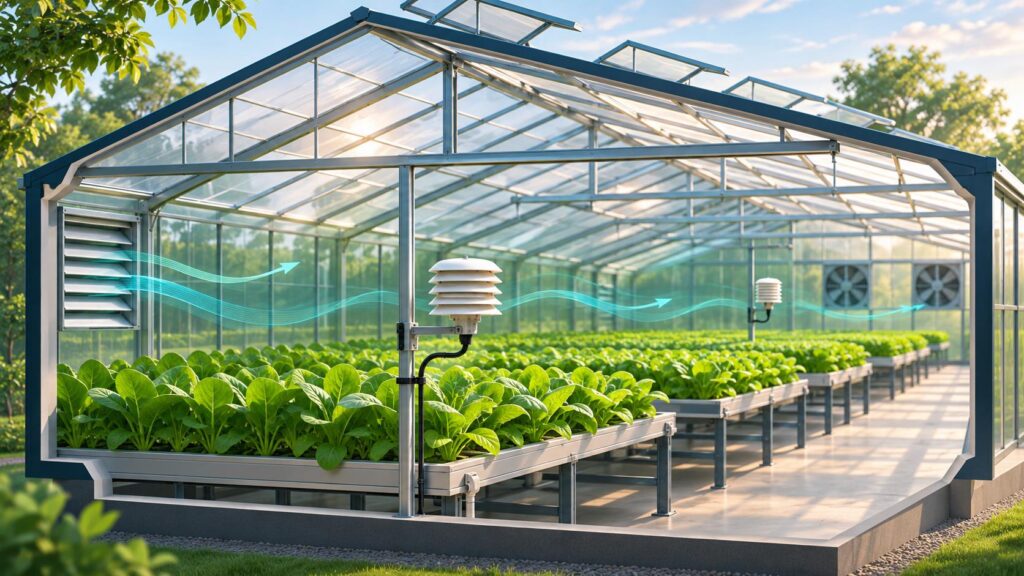
Greenhouse VPD monitoring uses temperature and humidity measurements to describe the atmospheric demand for water vapour. VPD means vapor pressure deficit and is commonly reported in kilopascals. Its usefulness depends on representative measurements, a clearly defined calculation and an understanding of the crop. A precise number from a poorly placed sensor can still lead to the wrong decision.
For growers and system integrators, the first task is to define what the value represents: greenhouse air at a measuring point or an estimate of the difference between leaf and surrounding air. Then document the sensor location and calculation before connecting the result to an alarm or control action.
Distinguish air VPD from leaf-to-air conditions
Air VPD is the difference between saturation vapour pressure at air temperature and the actual vapour pressure in that air. Relative humidity supplies the relationship between actual and saturation vapour pressure. Changing temperature can therefore change the calculated VPD even when a humidity percentage looks familiar.
A leaf-to-air estimate additionally depends on leaf temperature and its assumptions. Do not label an air-only calculation as a measured leaf condition. If a controller includes a fixed leaf-temperature offset, record it and assess whether it fits the crop and conditions. The greenhouse monitoring solution provides a starting point for planning the measurement points and integration requirements.
Position temperature and humidity sensors together
Place the temperature and humidity measurements close enough to represent the same air. Protect the sensing assembly from direct radiation using an appropriate ventilated shield. Keep it out of direct spray and follow the sensor's requirements for airflow, condensation and maintenance. A shaded but stagnant enclosure can create its own measurement problem.
Choose representative canopy-level locations and document their height relative to the crop. Avoid treating a point beside a door, heater or supply jet as a greenhouse average without checking the surrounding area. As plants grow or benches move, review whether the original location still represents the intended zone.
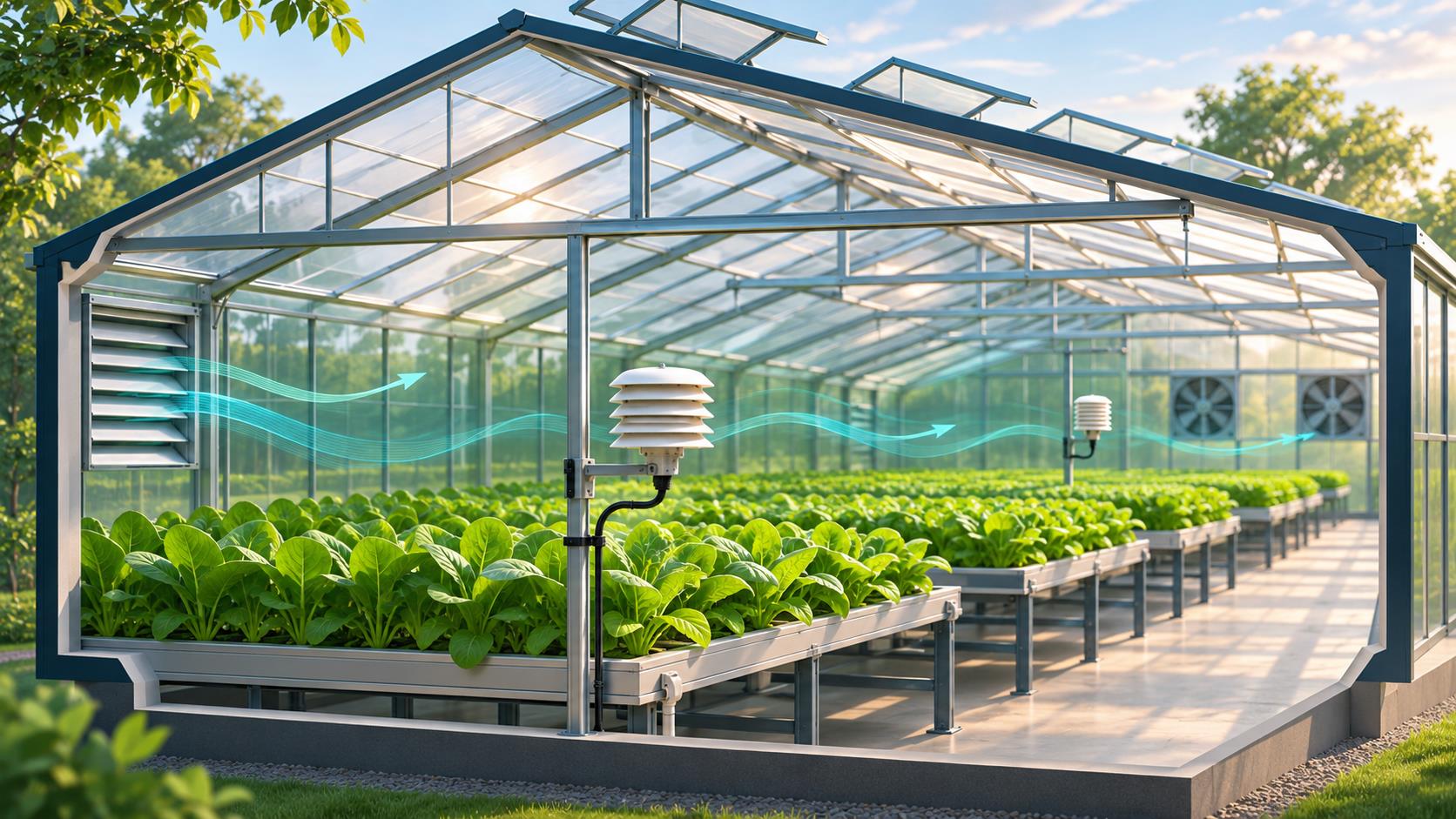
Survey zones before deciding how many sensors to install
Prepare a simple plan of doors, vents, heating equipment, irrigation areas and crop blocks. Compare candidate measurement points during relevant operating periods. Include transitions such as ventilation changes and irrigation rather than relying only on a quiet period when the greenhouse appears uniform.
Use the survey to decide which zones need independent monitoring. There is no universal spacing that suits every greenhouse. Record why each permanent point was selected and what action its reading supports. Compare available temperature and humidity sensor configurations against the actual exposure and mounting requirements; a model name alone does not establish suitability for a wet growing area.
Preserve the inputs as well as the calculated value
Store the original temperature, relative humidity, timestamp and sensor identifier alongside VPD. Document units, calculation version, averaging interval and any leaf-temperature assumption. This allows a later reviewer to separate a sensor problem from a configuration change. Confirm that the controller handles missing or invalid inputs explicitly instead of silently retaining an old value.
Keep observations about ventilation, screens, irrigation and crop stage with the climate record. Review short events and sustained conditions separately. An average can hide a temporary excursion, while a brief spike may reflect maintenance or a local disturbance. Decide in advance how long a condition must persist before an operator is notified.
Use crop-specific targets and verify the measurement chain
Choose control targets with the grower's agronomic guidance for the crop, growth stage and production system. VPD alone does not establish irrigation need, plant health or disease status. Root-zone conditions, light, airflow and the management objective remain relevant. Avoid applying a single internet chart as a universal crop prescription.
Inspect and compare sensors periodically with a suitable reference under representative conditions. Review fouling, shield condition and location after maintenance. For larger projects, specify these responsibilities in the smart agriculture sensor plan so that data quality remains part of normal operation.
Frequently asked questions
Can two areas with the same relative humidity have different VPD?
Yes. Air temperature also affects the calculation. Compare the paired temperature and humidity readings, not the humidity percentage alone.
Does adding a VPD display improve a poorly installed sensor?
No. The calculation inherits problems in its inputs. Confirm placement, radiation protection, condition and calculation settings before changing control targets.
Sources: Greenhouse environmental measurement guidelines, University of Georgia sensor placement guidance, METER atmospheric measurement manual.